The 12-year total cost of ownership of a garage floor
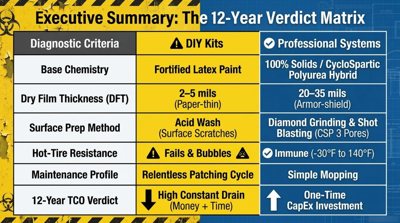
Every garage floor decision looks affordable on the day of installation. The number that matters is the one you are still paying at year twelve. A kit coating and a professionally installed system start out looking like two points on the same line, then diverge — and the divergence is not only financial.
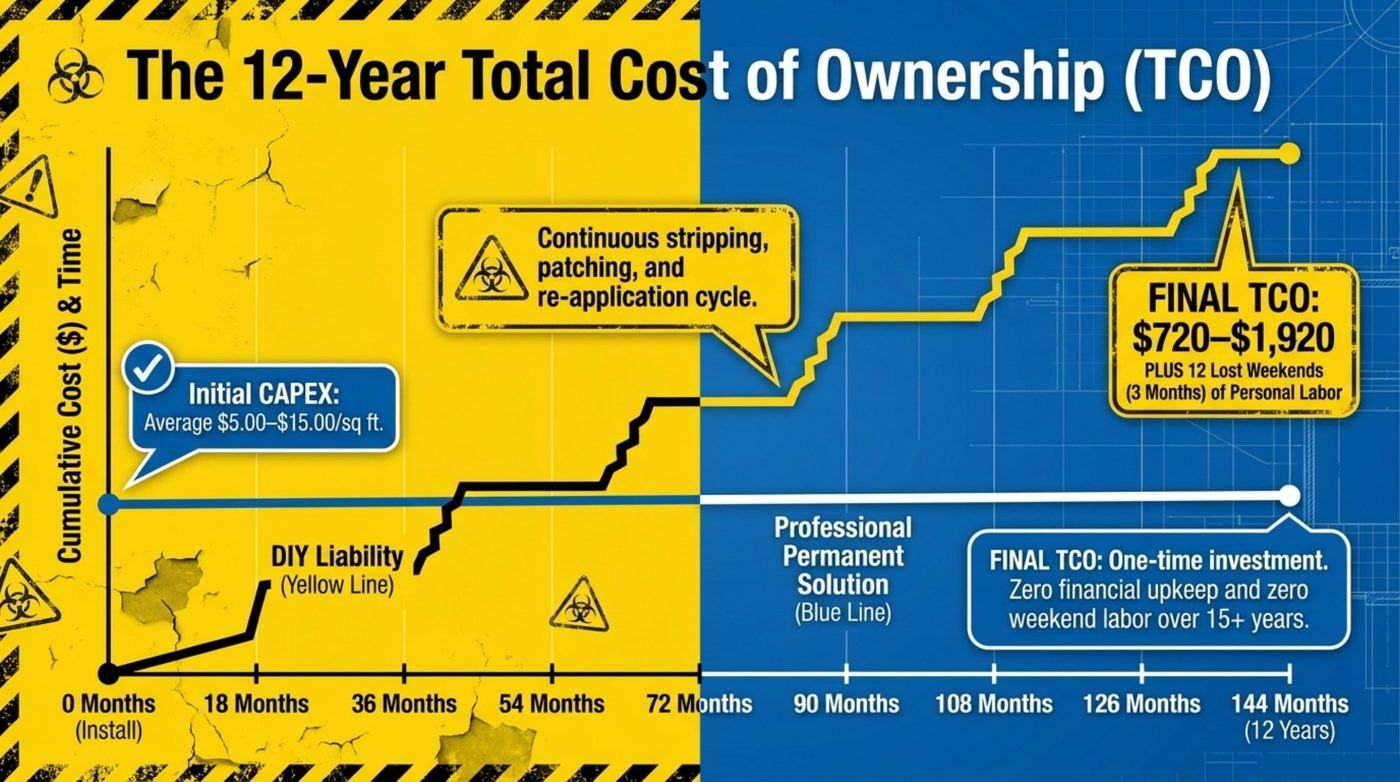
The 12-year total cost of ownership chart tracks two lines across a 144-month horizon. One climbs in steps as the coating is stripped, patched, and re-applied on a repeating cycle. The other runs flat after a single installation. Neither line is a guess; both are made of real material, real labor, and real weekends.
Here is what each line actually contains, and why the cheaper start so often ends as the more expensive floor for a Grand Rapids, Kentwood, or Holland homeowner.
What the DIY line actually costs
The kit path begins with a modest material purchase and then keeps spending. Cumulative cost and time rise together in a continuous stripping, patching, and re-application cycle that repeats for as long as the owner keeps the floor covered.
The final 12-year total cost of ownership for that path lands between $720 and $1,920 — real money, and not the whole bill. Add 12 lost weekends, which is roughly 3 months of personal labor pulled out of the calendar and spent on a concrete slab instead of anything else. That labor is unpaid, which is exactly why it usually disappears from the comparison.
What the professional line actually costs
The professional line starts higher and then stops. Initial capital expenditure for a full system averages $5.00 to $15.00 per square foot, depending on slab condition, system type, and the amount of surface preparation required.
After that installation, the line is flat. The final total cost of ownership is a one-time investment with zero financial upkeep and zero weekend labor over 15+ years. No stripping. No patching cycles. No re-application every few seasons, and no repeat of the cure wait.
The 144-month timeline, milestone by milestone
The chart's horizontal axis runs in 18-month steps from installation out to 144 months — the full 12 years. Each step on the DIY line carries another entry, another set of materials, and another weekend; the professional line does not move after month zero.
| Horizon | DIY kit path | Professional system |
|---|---|---|
| Month 0 (install) | First material purchase, labor begins | One-time capital expenditure, $5.00–$15.00/sq ft |
| Month 18 | First stripping, patching, and re-application | No spend, no labor |
| Months 36–72 | Cycle repeats; cumulative cost and time climb | No spend, no labor |
| Months 90–126 | Continued re-coating every season or two | No spend, no labor |
| Month 144 (12 years) | Final total cost of ownership: $720–$1,920 plus 12 lost weekends (3 months of personal labor) | One-time investment, zero upkeep and zero weekend labor over 15+ years |
The cost that never appears in a quote
Material receipts are easy to track. The 12 lost weekends are not, which is why they get written off as free. Put a value on 3 months of personal labor and the DIY line usually stops being the cheaper option well before the 12-year mark.
There is also an exposure cost. A recurring cycle of patchwork means living with a floor that is never quite finished — fresh patches next to faded panels, in a garage the whole neighborhood sees when the door comes up in a Walker or East Grand Rapids driveway.
Three places the DIY line hides its cost
The first is the cycle itself. A re-application is never just paint over paint; the failed film has to come off, the concrete underneath has to be cleaned, and the new layer has to bond to something that has already proven it will not hold. That preparation repeats on every step of the climbing line.
The second is material drift. Each cycle consumes new product, and the homeowner is buying in small quantities at retail rather than in specification quantities. The final $720 to $1,920 reflects that accumulation across twelve years, spread out in increments small enough that no single purchase feels like a decision.
The third is the timing constraint. Every re-application means the garage is out of service for another cure window, and every cure window lands on a calendar the homeowner does not control. A West Michigan winter, with five months of salt and brine underfoot, is not a good time to be waiting on a film to dry with a car sitting in the driveway.
How to read a square-foot price
The $5.00 to $15.00 per square foot range is wide on purpose. A clean, dry, sound slab in a newer Holland build sits near the bottom. A weathered slab with previous coating failures, moisture, or heavy oil saturation needs more preparation and sits near the top. The spread is a condition report, not a sales tactic.
Compare any quote against the 12-year horizon rather than the installation date, and the range becomes much easier to place. The relevant question is not which number is smaller today, but which one stops moving.
Frequently asked questions about 12-year garage floor cost of ownership
Is $720–$1,920 really the whole cost of the kit path?
It is the final total cost of ownership for materials across the 12-year window as shown on the chart, and it excludes the 12 lost weekends of labor. Counting that unpaid time is what changes the comparison for most homeowners.
Why do professional systems claim zero upkeep?
Because the system is built to be cleaned rather than rebuilt. A full solids build handles traffic, chemicals, and freeze-thaw without a scheduled re-application cycle, so the homeowner's calendar stays clear and the spending stops after installation.
Does the 15+ year figure mean nothing is ever needed again?
It means no financial upkeep and no weekend labor. Routine cleaning continues, and any physical damage to a slab should still be assessed — but there is no recurring stripping, patching, and re-application program driving the budget. Our cost breakdown for Grand Rapids garages walks through how those numbers land on a local slab.
Before you commit to a 12-year plan, run both lines against your own square footage — the flooring calculators do it in a minute, and the cost calculator shows where West Michigan pricing sits. Then call Grand Rapids Epoxy Floors at (616) 616-7460 to talk through the installation side of the number.