The layer build-up: spread rates for every coat and broadcast
Spread rate is the quiet number that decides whether a garage floor in Grand Rapids lasts fifteen years or fifteen months. It is the area one gallon of resin is expected to cover, and when a crew stretches material to cover more floor than the specification allows, the film gets thinner without anything visibly changing on installation day. The floor looks finished. It is just thin. This is written for homeowners around Grand Rapids, MI who are looking into concrete coating installers and want the honest version rather than a sales page.
The system described here is a 100% solids double-broadcast build, which means the resin contains no solvent to evaporate away — what is applied is what stays as film. That makes spread rate directly convertible into film thickness, and it makes the numbers checkable. Every coat in the stack has a published range, and every broadcast has a published coverage rate per 100 pounds of aggregate.
The short version
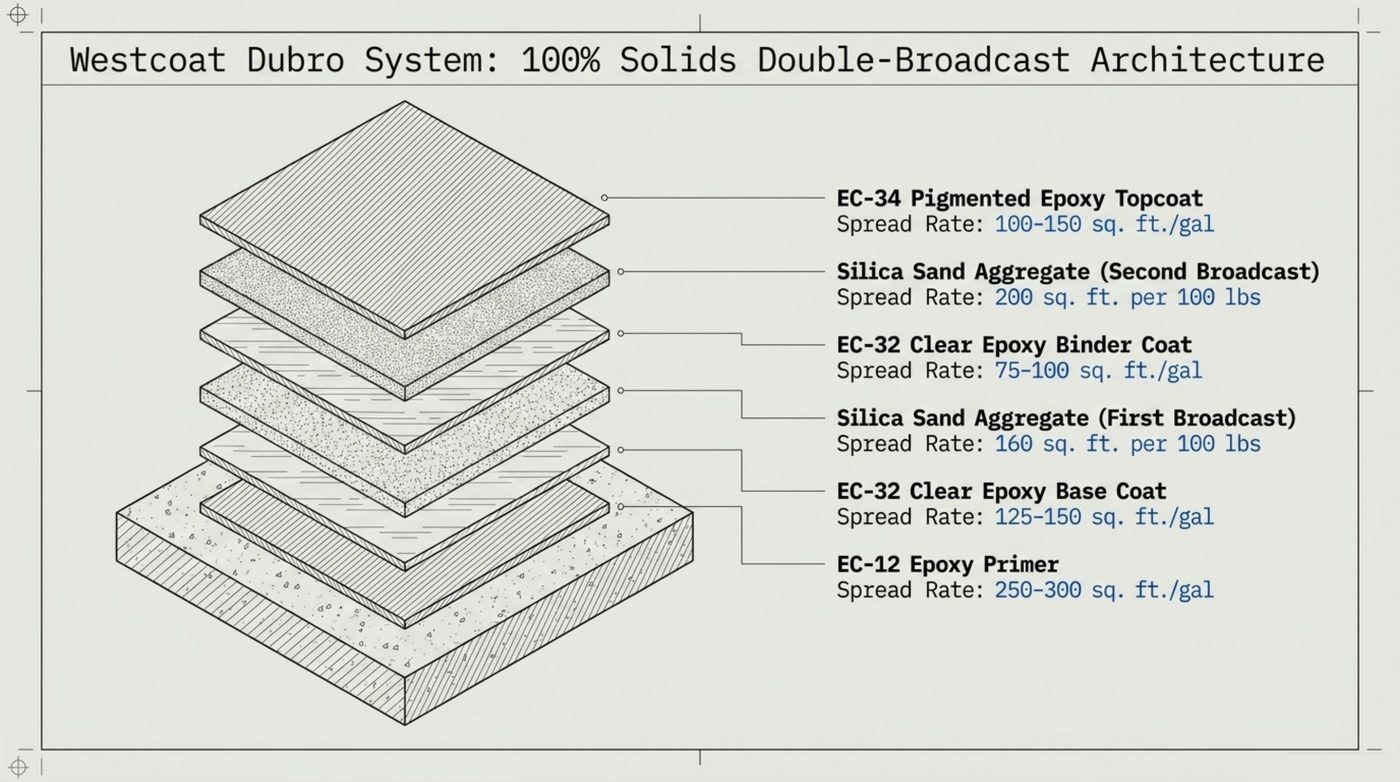
- The published rates are primer at 250 to 300 sq ft per gallon, clear base coat at 125 to 150, a first silica sand broadcast at 160 sq ft per 100 lbs, and a binder coat at 75 to 100.
- The binder coat is the heaviest wet-coat rate in the stack because it must saturate the aggregate already down and stay receptive to the second broadcast without flooding it.
- The second silica sand broadcast runs at 200 sq ft per 100 lbs, lighter and more uniform than the first, to fill valleys and build a dense level matrix.
- The pigmented epoxy topcoat at 100 to 150 sq ft per gallon is the highest material concentration in the build and corresponds to the specified 15 mil performance wear layer.
- Because 100% solids resin has no solvent to evaporate, the published spread rate converts directly to film thickness, so a quote can be sanity-checked by dividing square footage by gallons.
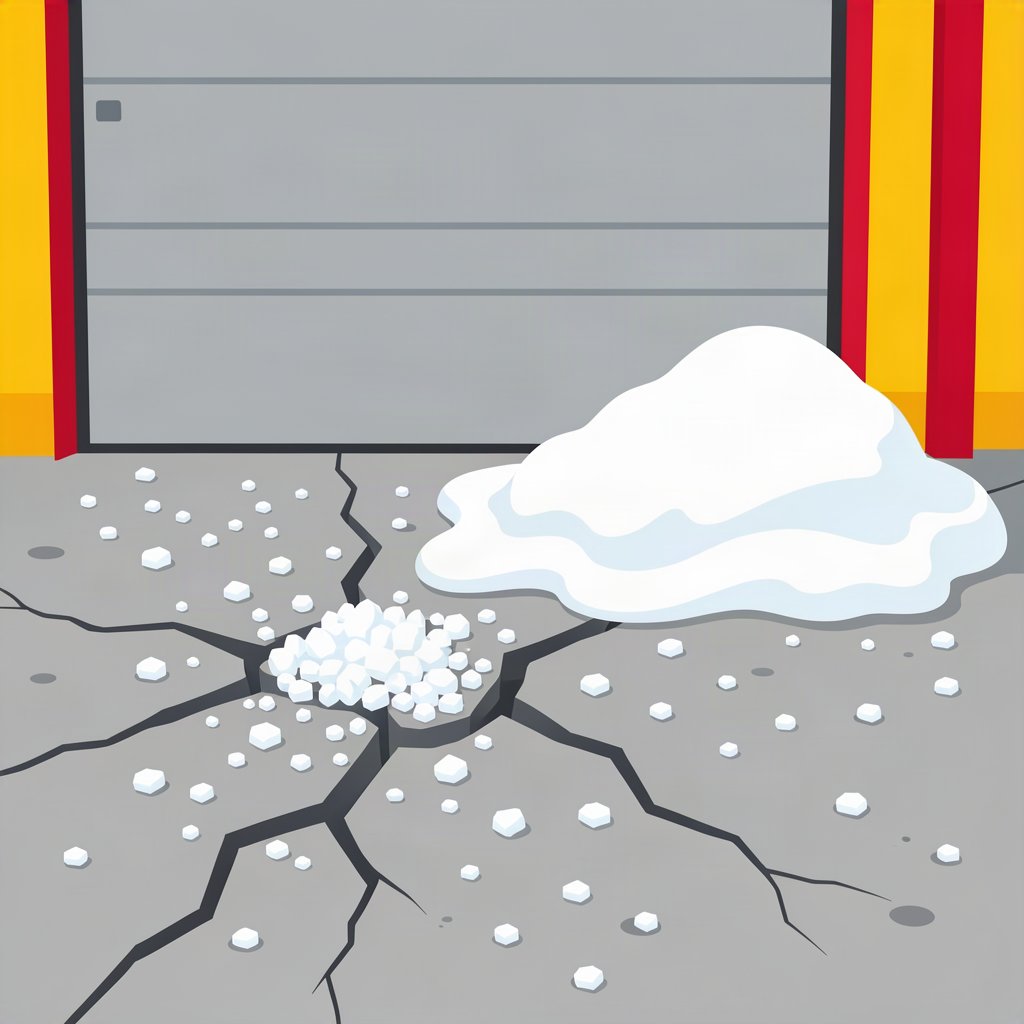
- Wear-through from stretched rates shows up first at hot-tire spots and the garage door apron, the two places where road salt and brine from I-96 pile up.
Read the numbers as a recipe. Deviate below the stated coverage and the film under-builds; deviate above it and you are paying for material that never made it onto the floor.
Starting at the bottom: primer and base coat
The first layer down is the epoxy primer, spread at 250 to 300 square feet per gallon. It is the thinnest wet coat in the system because its job is to wet out the profile opened by surface preparation and seal the porosity of the slab, not to build thickness. At that rate the primer penetrates the CSP 3 to 4 surface rather than sitting on top of it, which is exactly what the base coat needs underneath.
Next comes the clear epoxy base coat at 125 to 150 square feet per gallon. That is roughly half the coverage of the primer, which is how the build deepens substantially while consuming only one more gallon per area. Everything above this point depends on the base coat being thick enough to hold the first broadcast of aggregate without drowning it.
Silica sand is then broadcast into the wet base coat at 160 square feet per 100 pounds. That application is what turns a glossy film into a textured, mechanically keyed surface, and it is the first of the two broadcasts that define the system.
The binder coat and the second broadcast
Once the first broadcast has been absorbed, the clear epoxy binder coat goes down at 75 to 100 square feet per gallon — the heaviest wet-coat rate in the entire stack. The binder has to do two jobs at once: saturate the aggregate that is already there, and stay wet long enough to receive the second broadcast. A binder applied too thin leaves loose grain at the surface; too thick and it floods the first layer.
Silica sand is broadcast again at 200 square feet per 100 pounds. Note the direction of that number: 200 square feet per 100 pounds covers more area per pound than the first broadcast at 160, which makes the second application lighter and more uniform. The purpose is not to add more grit for its own sake, but to fill the valleys between the first-pass grains and produce a dense, level matrix.
Together, the two broadcast rates are what separate a double-broadcast floor from a single-broadcast one. The aggregate is not decoration; it is the wear surface, held in resin that has been spread to a calculated rate in each layer.
Closing the system with the pigmented topcoat
The final wet coat is a pigmented epoxy topcoat at 100 to 150 square feet per gallon. That is the highest material concentration per square foot of any resin layer in the build, and it corresponds to the 15 mil performance wear layer the specification calls for. The topcoat seals the broadcast aggregate, provides the color the floor is judged on, and becomes the surface that tires, jacks and shovels actually touch.
Because it is pigmented rather than clear, any thin area in the topcoat shows as a color variation — lighter or darker patches where coverage dropped. That makes the topcoat the easiest layer to audit after the fact. Uniform color across a Grand Rapids or Wyoming floor means uniform coverage down to the stated rate.
| Layer | Spread rate | Role in the build |
|---|---|---|
| Epoxy primer | 250-300 sq. ft. / gal | Wets out the profile, seals slab porosity |
| Clear epoxy base coat | 125-150 sq. ft. / gal | Builds the film that holds the first broadcast |
| Silica sand (first broadcast) | 160 sq. ft. / 100 lbs | Keys aggregate into the bond line |
| Clear epoxy binder coat | 75-100 sq. ft. / gal | Saturates existing grain, receives the second broadcast |
| Silica sand (second broadcast) | 200 sq. ft. / 100 lbs | Fills valleys, builds the dense wear matrix |
| Pigmented epoxy topcoat | 100-150 sq. ft. / gal | Seals aggregate, provides color and the wear surface |
Read top to bottom, the rates tell the story of the system. Coverage starts wide at the primer, tightens through the base and binder coats, and finishes at the highest material load in the build with the pigmented topcoat.
How to check a quote against these rates
You can use spread rates as a rough sanity check on any estimate you collect in Kentwood or Walker. Ask how many gallons of each product the job calls for, then divide the square footage of your garage by that number. The result should land inside the published ranges above for each coat.
- Primer: divide your square footage by 250 to 300 to estimate gallons.
- Base coat and binder coat: expect roughly one gallon per 125 to 150 and 75 to 100 square feet respectively.
- Aggregate: expect 100 pounds of silica sand per 160 square feet on the first broadcast and per 200 square feet on the second.
- Topcoat: expect one gallon per 100 to 150 square feet, the heaviest material use in the system.
If the numbers come back far above the range — for example, a job quoted at significantly less material than the rate suggests — the film you are buying is thinner than the system described.
Frequently asked questions about spread rates and broadcast
Why does the binder coat cover less area than the base coat?
The clear epoxy binder coat is spread at 75 to 100 square feet per gallon versus 125 to 150 for the base coat, because it has to do more work: saturate the aggregate already on the floor and stay receptive to the second broadcast without flooding it. Thicker material at that layer is intentional.
What does 100% solids mean for these numbers?
It means there is no solvent in the resin to evaporate. The wet material you apply becomes the dry film, so the published spread rate converts directly to film thickness. That is why the topcoat at 100 to 150 square feet per gallon corresponds to the specified 15 mil wear layer.
What happens if a contractor stretches the spread rate?
The film under-builds across the whole system. The floor still looks finished, but the topcoat thins below spec, the aggregate sits closer to the surface, and wear-through at hot-tire spots and the garage door apron — the two places road salt and brine from I-96 pile up — happens years earlier than it should.
A floor quoted in gallons per coat and pounds of aggregate is a floor you can audit. Grand Rapids Epoxy Floors helps homeowners in Grand Rapids, Kentwood, Wyoming, East Grand Rapids, Rockford and Holland compare providers who quote real material rates — call (616) 616-7460, run the numbers with our cost and coverage tools, or review the epoxy flooring cost guide for West Michigan.