DIY epoxy kit vs professional coating: the 12-year comparison
A $60 to $160 box kit from a Grand Rapids hardware store and a professionally installed system at $4 to $7 per square foot look like two versions of the same purchase. They are not. They are two different products with two different lifespans, and the gap only becomes visible after the floor has been driven on, salted, and baked through a dozen West Michigan summers.
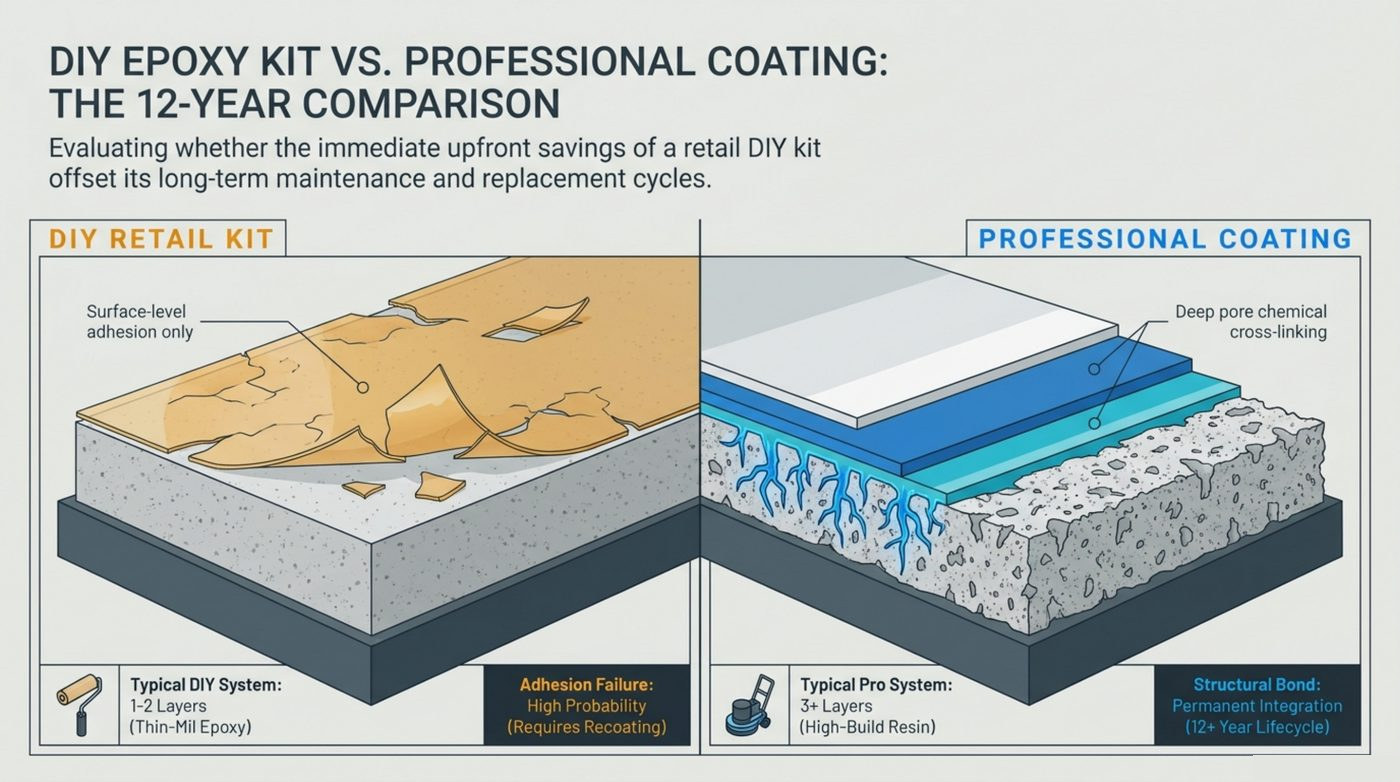
This comparison runs the full 12 years, because that is the window where the cheap option stops being cheap. A retail kit is a thin-mil epoxy applied in one or two layers and held to the slab by surface-level adhesion alone. A professional system is a high-build resin applied in three or more layers that cross-links into the pores of the concrete itself. One of those two floors gets recoated. The other gets swept.
Homeowners across Grand Rapids, Kentwood, Walker, Wyoming, Grandville, East Grand Rapids, Rockford, and Holland ask the same question every spring: can I just do it myself and save the money? The honest answer is that you can do it yourself, and then you will likely do it again, and again, inside the same 12 years. Here is how that plays out in real numbers.
Layer count is the first real difference
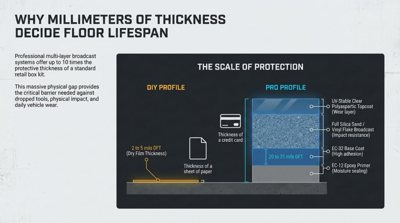
A typical DIY system is one to two layers of thin-mil epoxy. Each coat goes on at a fraction of the thickness a professional installer works with, and there is no broadcast aggregate built into the film. The floor looks finished the weekend it is applied and starts showing wear the first winter a car pulls in with road salt on the tires.
A typical professional system is three or more layers of high-build resin. That build-up is what allows the system to absorb impact, resist abrasion, and carry a broadcast layer of silica sand or vinyl flake that gives the surface both texture and sacrificial thickness. More layers mean more material, more cure time, and more labour, which is exactly what the upfront price difference is buying.
Layer count also decides what happens when the floor is damaged. A one-layer floor has nothing underneath to lose, so a chip or a peel exposes bare concrete immediately. A three-layer floor loses a wear layer and still has a base coat holding the slab.
Surface adhesion versus deep pore cross-linking
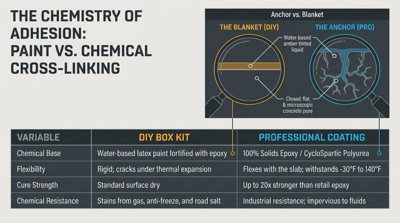
Retail kits bond to the surface of the concrete. The chemistry is designed to sit on top of the slab and grip what it can reach, which is why the failure mode is so consistent: an adhesion failure that starts at an edge, a crack, or a hot-tire footprint, then spreads as water gets underneath. Once that begins, the only repair is a full recoat.
Professional systems bond through chemical cross-linking into the open pores of the concrete. The resin does not just sit on the slab, it locks into it, which the industry describes as a structural bond rather than a coating bond. That is the difference between a floor integrated with the concrete and a floor draped over it.
| Comparison point | DIY retail kit | Professional coating |
|---|---|---|
| Layers applied | 1 to 2 layers, thin-mil epoxy | 3 or more layers, high-build resin |
| Bond type | Surface-level adhesion only | Deep pore chemical cross-linking |
| Expected failure mode | High probability of adhesion failure, requires recoating | Structural bond, permanent integration |
| Lifecycle | Recoat cycles inside 12 years | 12+ year lifecycle |
What a 12-year lifecycle actually means
Twelve years is not a marketing figure. It is roughly the point at which a DIY floor has been recoated often enough that the total spend, the total weekends lost, and the total material purchased exceed what a professional system would have cost on day one.
A 12+ year lifecycle means the floor is still the original floor. It means no stripping, no grinding dust tracked through the house, and no moving the garage contents onto the driveway for a third time. For a two-car garage in Kent County, that is the entire argument.
Where the West Michigan climate widens the gap
West Michigan is hard on floor coatings in a specific way. Five months of MDOT road salt and brine arrive first, driving water and chloride into every small crack. Freeze-thaw cycling then opens those cracks a little wider, and summers push pavement temperatures high enough to soften thin thermoplastic films under a parked tire. A thin film does not have the material thickness to resist any of it on its own.
Cars in Walker, Kentwood, and Wyoming often sit on the same footprint of floor, tire for tire, day after day. That concentrated load is where a thin-mil system fails first. A high-build system spreads the same load across more material.
When a DIY kit still makes sense
There are cases where a retail kit is the right call: a rental you are leaving, a shed floor that never sees a vehicle, or a garage you plan to convert in two years. If the floor does not need to survive a dozen winters of salted tires, the cheap option is genuinely cheap.
For a primary garage in Grand Rapids, Grandville, East Grand Rapids, Rockford, or Holland, a floor you will look at every morning for the next decade, the 12-year view is the one that matters.
Frequently asked questions about DIY vs professional epoxy coatings
How much does a DIY epoxy kit cost compared to professional installation?
A retail kit runs about $60 to $160, and professional installation runs roughly $4 to $7 per square foot. For a standard two-car garage the upfront difference is real, and the 12-year totals land much closer together once recoating material and labour are counted.
Why do DIY epoxy floors peel?
Because they bond to the surface only. With one or two thin layers and no mechanical profile in the concrete, there is nothing for the film to lock into, so an adhesion failure is likely and usually ends in a full recoat.
How long does a professional epoxy floor last?
A properly prepped multi-layer system is built around a 12+ year lifecycle, with sweeping and mopping as the only routine maintenance. A retail kit, by contrast, is expected to need recoating inside that same window.
If you are weighing the two options for a garage in West Michigan, start with the numbers: our Grand Rapids cost guide breaks down per-square-foot pricing, and the installation checklist shows what a proper multi-layer install includes. Then call Grand Rapids Epoxy Floors at (616) 616-7460 and we will help you compare local providers, with no obligation.