The financial verdict: DIY vs professional over 12 years
The upfront comparison is the one homeowners in Grand Rapids, Kentwood, Walker, Wyoming, Grandville, East Grand Rapids, Rockford and Holland see first, and it always favours the box kit. A retail kit costs $60 to $160. A professional system lands between $4 and $7 per square foot. That gap is real, and it is the reason most DIY floors get installed in the first place.
The verdict changes when you extend the timeframe to 12 years. That is long enough for a DIY system to cycle through recoating, for the fuel and material to add up, and for the weekends spent scraping and re-rolling to become the dominant cost. A professional system has no such cycle.
The short version
- The article puts DIY recurring material costs at $720 to $1,920 over 12 years, against $0 for a professional system across its 12-to-15-year lifespan.
- It quantifies the do-it-yourself labour toll as three full months, or 12 full weekends, of preparation, mixing, recoating, and stripping old film.
- The $60-to-$160 kit price is only the start, since a two-car garage typically needs more than one kit plus etching acid, a mixer, and possibly a rented grinder.
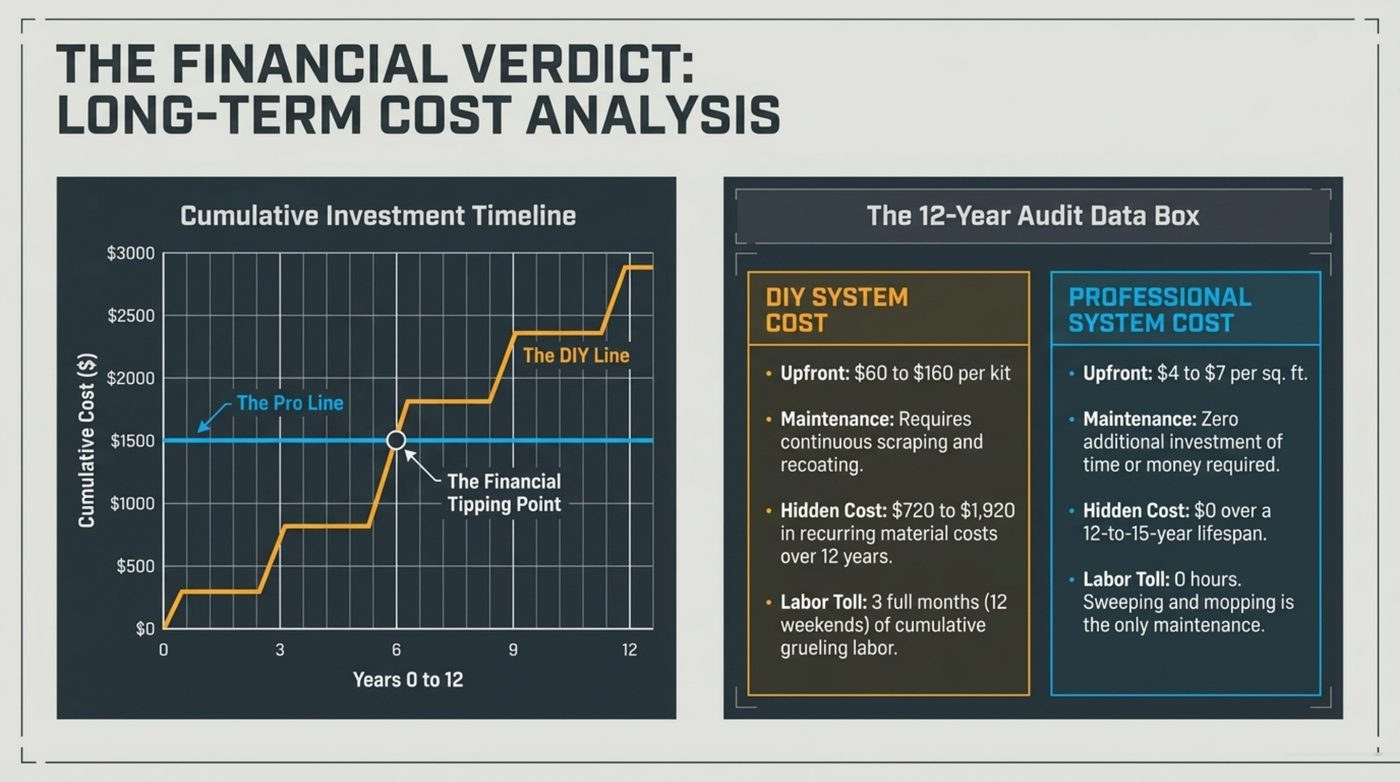
- The article says the two spending lines cross at a tipping point inside the 12-year window, with the professional line stepping once and then staying flat.
- It argues a per-square-foot quote should state layer count, dry film thickness, and whether mechanical grinding to a surface profile of 3 to 4 is included.
- Plotted from year 0 to year 12 on a $0-to-$3,000 scale, most West Michigan garages see the DIY line catch the professional line mid-window.
Here is the same two options measured on the numbers that actually matter over 12 years: upfront cost, hidden cost, and labour toll.
The upfront numbers
The DIY system starts at $60 to $160 per kit. A two-car garage typically needs more than one kit, so multiply that across the square footage and the entry price rises before you have bought a roller, a mixing paddle, or the etching acid.
The professional system is quoted at $4 to $7 per square foot. For the same two-car garage that is a real number, one that includes grinding equipment, HEPA extraction, multi-layer materials, and a crew that has done the sequence before.
The upfront gap is the entire argument for going DIY. Everything after the first summer is the argument against it.
The hidden costs nobody quotes at the store
Recurring material costs for a DIY system run $720 to $1,920 over 12 years. That is not a maintenance budget, it is the price of the coating failing and being replaced, again and again, on the same slab.
The professional figure is $0 over a 12-to-15-year lifespan. The system is expected to remain the original floor, so there is no recurring material line at all.
Maintenance is where the two paths diverge further. A DIY floor requires continuous scraping and recoating. A professional floor requires sweeping and mopping, which is a chore rather than a project.
Counting the labour toll
The labour toll for a DIY system across 12 years is 3 full months of cumulative labour, which works out to 12 full weekends. That total includes preparation, mixing, recoating, and the stripping of the old film before each recoat.
The professional labour toll is 0 hours. The homeowner sweeps and mops, and the floor stays put.
Twelve weekends is a summer of Saturdays. It is the part of the DIY calculation that never appears on the receipt, and it is usually the part homeowners regret.
| 12-year cost line | DIY system | Professional system |
|---|---|---|
| Upfront cost | $60 to $160 per kit | $4 to $7 per sq. ft. |
| Maintenance | Requires continuous scraping and recoating | Zero additional investment of time or money |
| Hidden cost | $720 to $1,920 in recurring material costs over 12 years | $0 over a 12-to-15-year lifespan |
| Labour toll | 3 full months (12 weekends) of cumulative labour | 0 hours, sweeping and mopping only |
The financial tipping point
The two lines cross at the tipping point, and it falls well inside the 12-year window. Upfront cost plus hidden cost plus the value of 12 weekends is what pushes the DIY total past the professional total.
That is the number to carry into a conversation with any provider. It is not about which floor costs less on the day it is installed, it is about which floor has cost less by the time it is a decade old.
A professional system also holds its appearance across that period, which matters if the garage is visible from the street or the house is being prepared for sale.
What the cumulative line looks like
Plotted from year 0 to year 12, the two spending lines start far apart and converge. The DIY line steps up every time a recoat is needed. The professional line steps once at installation and then stays flat.
On a vertical scale from $0 to $3,000, most West Michigan garages see the DIY line catch the professional line somewhere in the middle of that window. Everything after the crossing point is money the DIY route spent twice for the same floor.
What to confirm before either number is final
A per-square-foot quote in West Michigan should also account for the freeze-thaw and MDOT road salt that slab will see every winter, and it should state the layer count, the dry film thickness it will reach, and whether the price includes mechanical grinding to a surface profile of 3 to 4. Without the grinding step the lower number is not comparing like with like, because a coating over a smooth slab will not reach the 12-to-15-year lifespan the professional line assumes.
On the DIY side, the honest comparison includes the second kit you will buy for a two-car garage, the cost of the etching acid, the grinder or etcher you may end up renting, and the 12 weekends. Add those to the $60 to $160 sticker price before deciding the upfront gap is as wide as it looks.
Homeowners in Wyoming, East Grand Rapids, and Kentwood who run the full 12-year total usually find the two lines much closer than the store shelf suggests, and that is before they put a value on three months of Saturdays.
Frequently asked questions about the 12-year cost comparison
Is a DIY epoxy kit cheaper than professional installation over 12 years?
Not once you add the numbers up. A kit costs $60 to $160, but the recurring material costs run $720 to $1,920 over 12 years, plus 3 full months of cumulative labour, against $0 in recurring cost for a professional system.
How much does professional epoxy flooring cost per square foot?
Professional installation runs about $4 to $7 per square foot, covering a multi-layer build over a properly ground slab. That number includes preparation, materials, and labour in one figure.
What does a professional floor need for maintenance?
Sweeping and mopping. There is no scraping, no recoating, and no additional investment of time or money across a 12-to-15-year lifespan.
If you want to run your own square footage through these numbers, the Grand Rapids tools hub has a cost calculator, and the Grand Rapids cost guide breaks the $4 to $7 per square foot range down by garage size. Call Grand Rapids Epoxy Floors at (616) 616-7460 and we will help you compare local providers, with no obligation.