The verdict matrix: DIY kits vs professional systems, criterion by criterion
Most garage floor arguments stall because the two sides are comparing different things. One person is talking about price at the register; the other is talking about what the surface will do in year six. The way out is a matrix — the same seven diagnostic criteria applied to both options, with the measured values side by side.
This is that matrix for West Michigan slabs. Kent County concrete spends five months under MDOT salt brine, then runs into freeze-thaw cycling, lake-effect moisture, and summer heat that an attached garage holds long past anything the air temperature suggests. Even a heated garage that stays above freezing all winter still tracks that brine across the slab every day. A coating has to answer for all of it.
Below, each criterion is explained before it is scored, because the numbers only mean something once you know what is being measured.
Base chemistry: fortified latex paint vs 100% solids
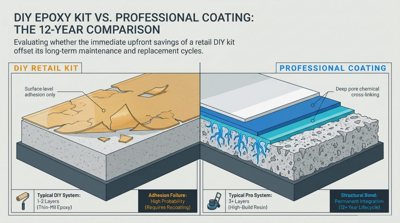
The single largest difference between a kit and a professional system is what the material is made of. Kit products are built on a fortified latex paint platform — a waterborne film that dries quickly, goes on thin, and binds to the surface rather than becoming part of it.
Professional systems use 100% solids chemistry, frequently a cycloaliphatic polyurea hybrid. There is no water to evaporate out of the film, so the coating cures into a dense, chemically resistant layer instead of drying into a shell. That distinction drives every other row in the matrix.
Film thickness: 2–5 mils against 20–35 mils
Thickness is where the argument usually ends. A kit coating leaves a dry film thickness of 2–5 mils — paper-thin in every practical sense. A tire turning on a hot slab, a dropped socket, or a dragged floor jack reaches the concrete through that film almost immediately.
A professional system builds 20–35 mils of dry film, an armor-shield thickness that carries impact and abrasion loads on top of the concrete rather than transmitting them through. That is roughly four to seven times the film, and it is the reason the two surfaces age so differently.
Surface preparation: acid wash vs diamond grinding and shot blasting
Preparation decides whether a coating stays attached. The kit method relies on an acid wash, which etches the top of the slab and leaves surface scratches — a profile that looks textured but does not open the concrete's pores for mechanical bonding.
Professional preparation uses diamond grinding and shot blasting to reach a CSP 3 pore profile, the industry's concrete surface profile standard for coating work. The slab is opened and profiled so the base coat locks in mechanically across the whole floor, not just where the acid happened to bite.
Hot-tire resistance and temperature range
Park a warm tire on a thin film in July and the coating can lift and bubble, permanently marking the parking spot. Kit coatings fail this test; the cycloaliphatic polyurea hybrid build is described as immune across a working range of -30°F to 140°F.
That range covers everything a West Michigan garage experiences: single-digit January mornings in Holland, and a sealed attached garage in Wyoming on a 98°F August afternoon where the slab surface runs far hotter than the air. The material does not care.
Maintenance profile and the 12-year verdict
Maintenance is where the matrix becomes a schedule. The kit path requires a relentless patching cycle — chips, stains, and re-coats stacked on top of one another. The professional path is simple mopping, with no re-application program attached.
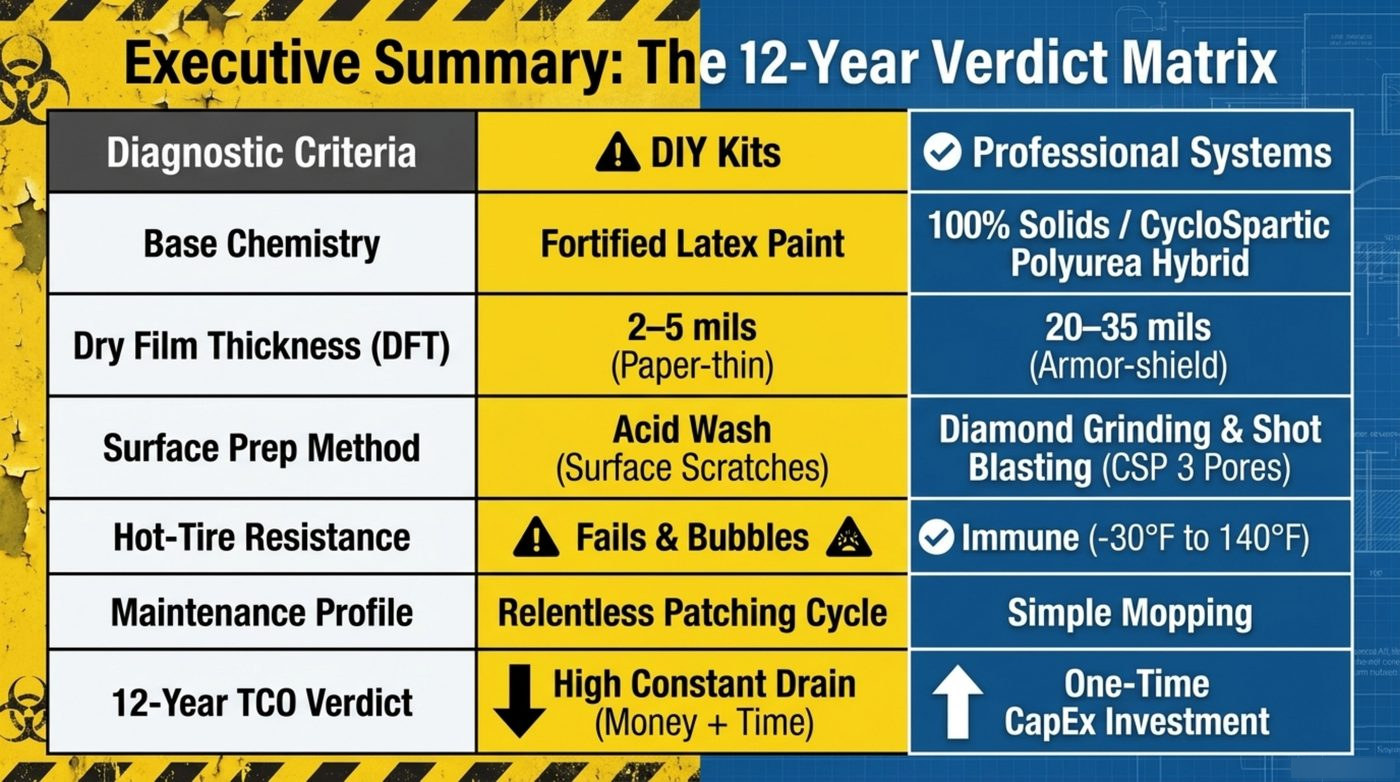
| Diagnostic criterion | DIY kits | Professional systems |
|---|---|---|
| Base chemistry | Fortified latex paint | 100% solids / cycloaliphatic polyurea hybrid |
| Dry film thickness (DFT) | 2–5 mils (paper-thin) | 20–35 mils (armor-shield) |
| Surface prep method | Acid wash (surface scratches) | Diamond grinding and shot blasting (CSP 3 pores) |
| Hot-tire resistance | Fails and bubbles | Immune across -30°F to 140°F |
| Maintenance profile | Relentless patching cycle | Simple mopping |
| 12-year TCO verdict | High constant drain (money plus time) | One-time capEx investment |
Read the matrix top to bottom and the verdict is not a matter of taste. Chemistry and thickness set the ceiling on performance; preparation determines whether that ceiling is reached at all. Everything a homeowner experiences later — the stains, the chips, the re-coating weekends — is downstream of those three rows.
Where the matrix changes in a real Grand Rapids garage
One more variable sits outside the table: weather during installation and the condition of the slab. A garage in Walker with a hairline-cracked, formerly sealed floor needs more preparation than a new pour in Grand Rapids, and both need a cure window that cooperates with West Michigan lake-effect humidity.
That is why the professional column in this matrix is not a product you can buy off a shelf. It is a process — profile, measure, build to thickness, broadcast texture, and top coat — and the process is what holds the numbers you just read.
It also explains why two quotes for the same square footage can differ by thousands of dollars in Kent County. The cheaper quote is usually holding the chemistry row constant and shaving the preparation, which is the one row the homeowner cannot inspect after the fact and the one that decides whether the film lets go in year three or year thirteen.
Frequently asked questions about DIY vs professional garage floor systems
Can a kit coating reach 20–35 mils if I apply extra coats?
No. Extra coats of a thin-film product build more film but not more adhesion or chemical depth, and each additional layer adds a bond line that can fail. Reaching armor-shield thickness means starting from a 100% solids base chemistry.
Is an acid wash ever enough preparation?
It etches the surface, which is an improvement over coating a dusty slab, but it does not create the CSP 3 pore profile that mechanical bonding requires. Diamond grinding and shot blasting are the preparation methods that match a 20–35 mil system.
What does hot-tire failure look like in practice?
It shows as a lifted, blistered patch exactly the shape of the tire contact area, usually where a car parks every day after a summer drive. Once it starts, water and salt get under the film and the surrounding coating begins to peel away from it. You can see the same failure mode described in our guide to epoxy flooring problems in West Michigan.
If you want the professional column of this matrix priced for your own slab, the flooring calculators and the comparison guides are the fastest starting point. For a straight answer on your garage, call Grand Rapids Epoxy Floors at (616) 616-7460.