Anatomy of a failure: hot tires, vapour pressure and blistered garage floors
It usually appears in July. A ring of raised, hollow-sounding blisters forms exactly where the tires sit, and the floor that looked flawless in May now has soft spots under the biggest vehicle in the driveway. Nothing was dropped on it. Nothing was spilled on it. The floor failed because of heat and moisture, and because of two properties of the coating that were decided long before the car was parked.
The mechanism is measurable: expanding moisture vapour, a rigid film, and a slab that moves. The outcome — bubbling and peeling under hot tires — is what happens when a coating cannot handle either the temperature or the vapour pressure coming from below.
The short version
- The article explains a blister as rising moisture vapour trapped under a rigid film, where a film that cannot stretch lifts into a dome at its weakest point.
- At 2 to 5 mils of dry film thickness, a rigid film is said to have almost no material to absorb stress, so it holds like a pane of glass then fails across a line.
- The flexible alternative is a fast-curing hybrid matrix building to 20 to 35 mils over a CSP 3-4 profile, flexing with the slab while holding a mechanical and chemical bond.
- Blistering is described as appearing first in the tire lanes, tracing two or four rectangles, and worsening in the sunny half of a two-car garage where pavement temperatures pass 100°F.
- Five months of MDOT brine tracked in from a Kent County street holds moisture against the surface, which becomes the next summer's vapour load under the coating.
- The article says the pre-purchase check is three questions: what dry film thickness the system finishes at, what surface profile the prep achieves, and what operating range the coating is rated for.
This is the failure that most often ends a thin DIY floor's life in a West Michigan garage, and it is worth understanding before you buy a system rather than after.
The sequence of a blister, step by step
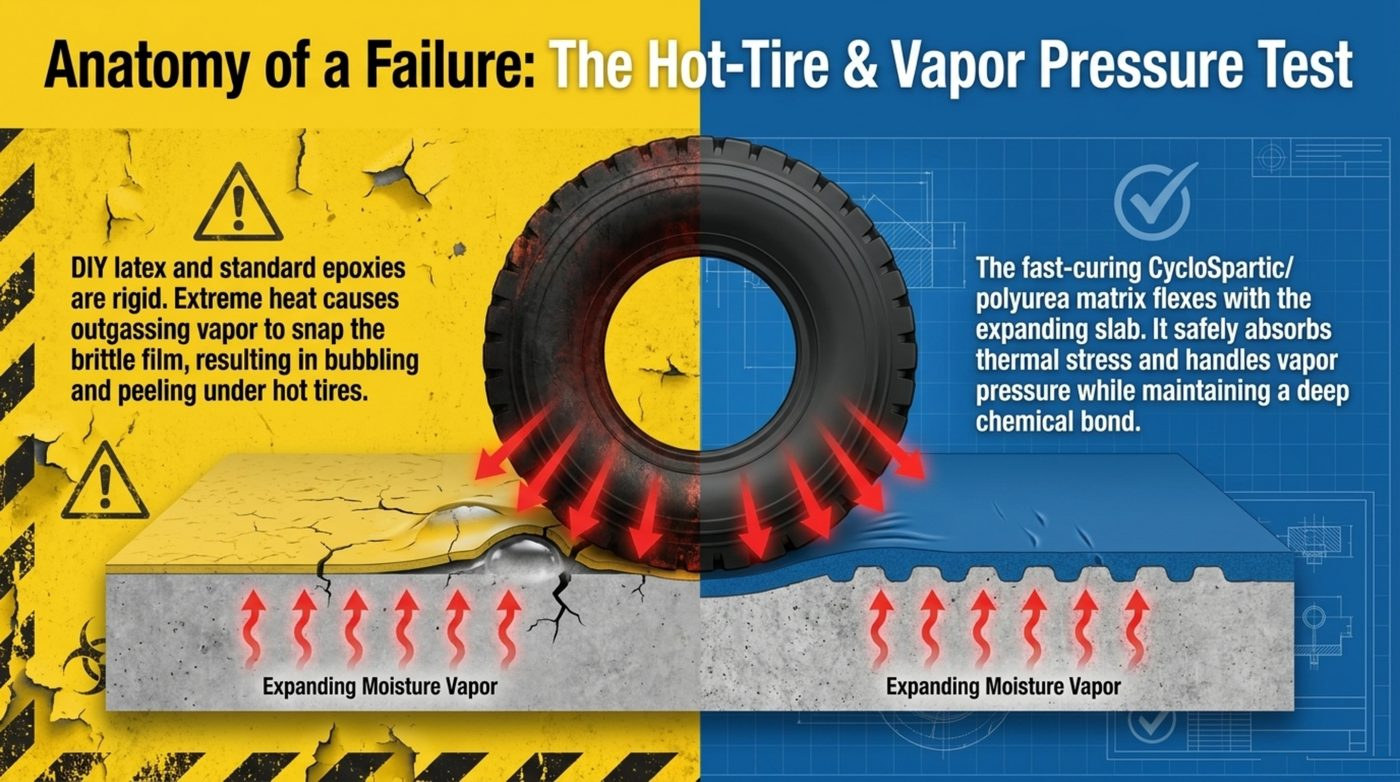
Concrete is porous and it holds moisture. In Grand Rapids, Kentwood, and Walker, that moisture comes from the ground, from five months of winter salt and meltwater, and from lake-effect summer air. On a warm day it migrates upward through the slab as vapour, which is normal and constant.
A hot tire adds concentrated heat to a small area of the surface. Extreme heat accelerates moisture vapour transmission, so vapour arriving at the underside of the coating speeds up exactly when the film above it is softest. Pressure builds in the space between the concrete and the film, looking for the path of least resistance.
If the film can stretch, the pressure spreads and dissipates. If the film cannot stretch, the pressure finds a weak point, lifts the coating into a dome, and the whole failure starts from a single pocket of vapour.
Why rigid films snap instead of stretching
DIY latex and standard epoxy coatings are rigid by formulation. They cure hard because that is what makes them scratch-resistant on a shelf test, and hardness is exactly the wrong property when the concrete underneath is moving and vapour is pushing upward.
At 2–5 mils DFT, a rigid film also has almost no material available to absorb stress. There is no thickness to stretch and no elasticity to share the load, so the film behaves like a pane of glass under a slow, warm push. It holds until it does not, then it fails across a line rather than deforming.
That is the "snap" in the failure sequence. A brittle film does not wear out gradually under hot tires — it fails suddenly and then spreads, which is why owners often describe the blisters as appearing overnight.
What a flexible matrix does differently
A fast-curing hybrid matrix is built around the opposite property. Rather than fighting the slab, it flexes with the expanding concrete, absorbs thermal stress, and continues to handle vapour pressure while maintaining a deep chemical bond.
Because the system builds to 20–35 mils DFT with a primer base, a decorative flake or quartz layer, and a UV-stable clear topcoat, there is physical material available to accommodate movement. The bond is also mechanical as well as chemical, because the concrete was opened to a CSP 3–4 profile before the coating went down. The system holds because the failure has to beat the concrete before it beats the bond.
The temperature range tells the same story in a single line: -30°F to 140°F. A coating rated across that window from -30°F to 140°F is a coating designed for a garage that sees both ends of it every year.
| Stage of the hot-tire test | Rigid DIY latex and standard epoxy | Fast-curing hybrid matrix |
|---|---|---|
| Film thickness in the tire lane | 2–5 mils DFT (paper-thin) | 20–35 mils DFT (armour-shield build) |
| Heat from a parked tire | Film softens and snaps under thermal stress | Flexes with the expanding slab and absorbs the stress |
| Rising moisture vapour | Outgassing vapour snaps the brittle film | Handles vapour pressure while holding the bond |
| Result at the tire contact patch | Bubbling and peeling | Surface unchanged |
| Thermal service range | Not built for extreme swings | -30°F to 140°F |
| Maintenance after failure | Relentless patching cycle | Simple mopping |
Why the problem shows up in the tire lanes first
Blistering is not random. It appears where the heat is applied, which is why the pattern usually traces four rectangles, or two if the second bay stays empty. In a Rockford or East Grand Rapids garage where one car parks in the same spot every night, the failure concentrates in a footprint you could draw from memory.
The same physics explains why a floor can look perfect in the shaded half of a two-car garage and fail badly in the sunny half. Direct sun drives pavement temperatures past 100°F and pushes the local moisture vapour rate higher, so the sunny bay gets both stresses at once.
Road salt makes half the year worse. Five months of MDOT brine tracked in from a Kent County street hold moisture against the surface, and that moisture becomes the next summer's vapour load underneath the coating.
How to check a floor for hot-tire risk before you buy
Three questions will tell you most of what you need to know. Ask what dry film thickness the system finishes at, because a 2–5 mil film and a 20–35 mil build behave in completely different ways under the same tire. Ask what surface profile the prep achieves, because a coating bonded to a CSP 3–4 profile has a bond that outlasts the concrete. And ask what operating range the coating is rated for, because a system rated from -30°F to 140°F is one that was designed around the conditions your garage already has.
On an existing floor, tap-test the tire lanes with a screwdriver handle or a coin. A hollow, drummy sound means the coating has already released from the slab, even if the surface still looks intact. That is the point at which a small repair becomes a full re-coat if you wait another season.
Frequently asked questions about hot tires and floor bubbling
Why do hot tires make epoxy bubble?
Heat accelerates moisture vapour transmission through the concrete while softening the coating above it. A rigid film has no ability to stretch, so the rising vapour pressure lifts it into a blister. DIY latex and standard epoxies are rigid, which is why bubbling and peeling appear under hot tires.
Will a thicker coating alone stop the blistering?
Thickness helps, but the chemistry has to flex with the slab. A 20–35 mil hybrid matrix absorbs thermal stress and handles vapour pressure while maintaining a deep chemical bond, whereas the same thickness of a rigid product would still crack.
Can blisters be repaired without replacing the floor?
Small areas can sometimes be cut out and re-bonded, but if the coating has released across the tire lanes, the loose material has to come off and the slab has to be profiled properly to CSP 3–4 before anything new is applied. Patching over a bond failure only postpones it.
If your floor is already drumming under the tires, get it assessed before the next hot stretch: call (616) 616-7460 for a free evaluation in Grand Rapids, Kentwood, Walker, Wyoming, Grandville, East Grand Rapids, Rockford, and Holland. You can also read our guide to common epoxy flooring failures or compare systems directly in the comparison guides.