Industrial flooring: polished concrete vs high-build epoxy
Two systems carry most of the warehouse and light-manufacturing floor area in West Michigan: polished concrete and high-build epoxy. Both are durable, both are specified in working buildings from Wyoming to Holland along the US-131 and I-96 corridors, and both cost real money. The mistake is treating them as competing versions of the same product. They are different answers to different operating questions.
This walkthrough covers the full technical diagnostic on the choice, from the build-up of each system through the performance comparison, the chemical hazard spectrum, the failure mechanics that decide whether an install lasts, and the decision logic that resolves the selection.
The framing that matters up front is the operating condition. Polished concrete suits clean, dry logistics and automated storage where lighting efficiency and low maintenance are the priority. High-build epoxy suits chemical processing, wet environments and intensive forklift traffic. Get that one question right and most of the remaining specification follows.
High-build epoxy: the heavy-duty baseline
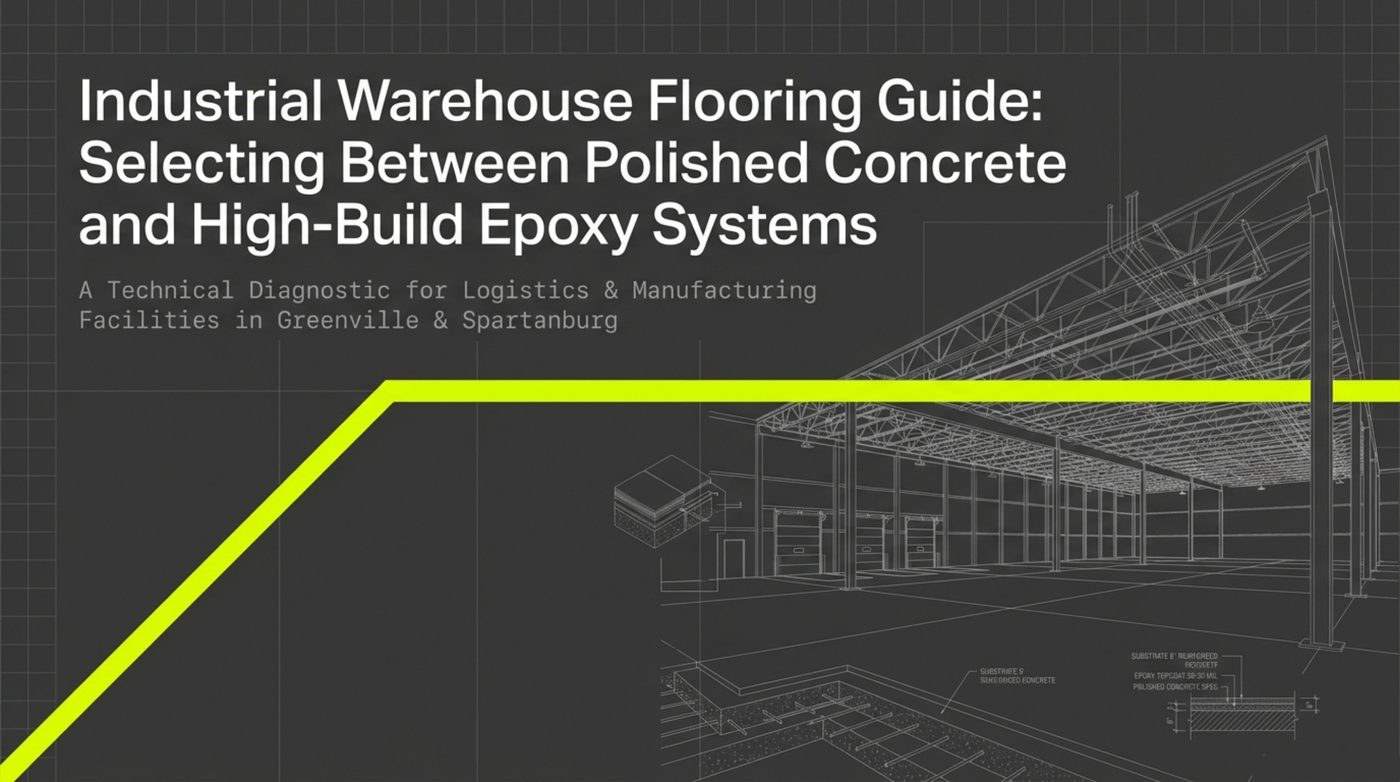
A high-build epoxy system is built in layers over a prepared slab, and each layer has a job. It starts with a concrete substrate that must be 2500 psi and cured for 28 days, then an epoxy primer for deep penetration bond, applied over a slab shot blasted to a CSP 3-4 profile.
From there the build continues: a clear epoxy base coat combined with silica sand to establish the first anti-skid matrix, a second coat with additional silica sand for the second anti-skid matrix, and a pigmented topcoat that provides the chemical and UV resistant finish. The total dry film thickness lands at 20-35 mils, with a joint-free, non-porous surface.
The performance rating for the system is heavy forklift and impact. That is what the silica sand matrices are for — they are not only about slip resistance, they also give the film a loaded surface that resists the scrubbing action of forklift tires turning under load. Two silica-reinforced coats, a pigmented finish and 20-35 mils of build is what lets a floor survive that kind of traffic in a Grand Rapids distribution bay.
Polished concrete: the low-maintenance baseline
Polished concrete takes the opposite approach: instead of building up, it works the slab itself and densifies it. Liquid densifiers penetrate the surface rather than coating it, which is where the system's defining benefit comes from — a high light reflectance value.
A high LRV means the slab reflects light instead of absorbing it, so a facility in Kentwood can specify fewer fixtures or run existing lighting at lower intensity and still hit target illuminance at floor level. The maintenance profile follows from the same logic: the surface is dustproof and easy to sweep or mop, with no film to chip at a joint.
Air quality is the other documented advantage. The system is low-VOC with zero outgassing, which makes it a natural fit for low-moisture storage and clean logistics operations where the building is sealed and the air handling is doing other work. What polished concrete does not do is hold up to aggressive chemical spills, and its impact resistance is rated moderate rather than extreme — a porous surface absorbs what lands on it.
The performance comparison, line by line
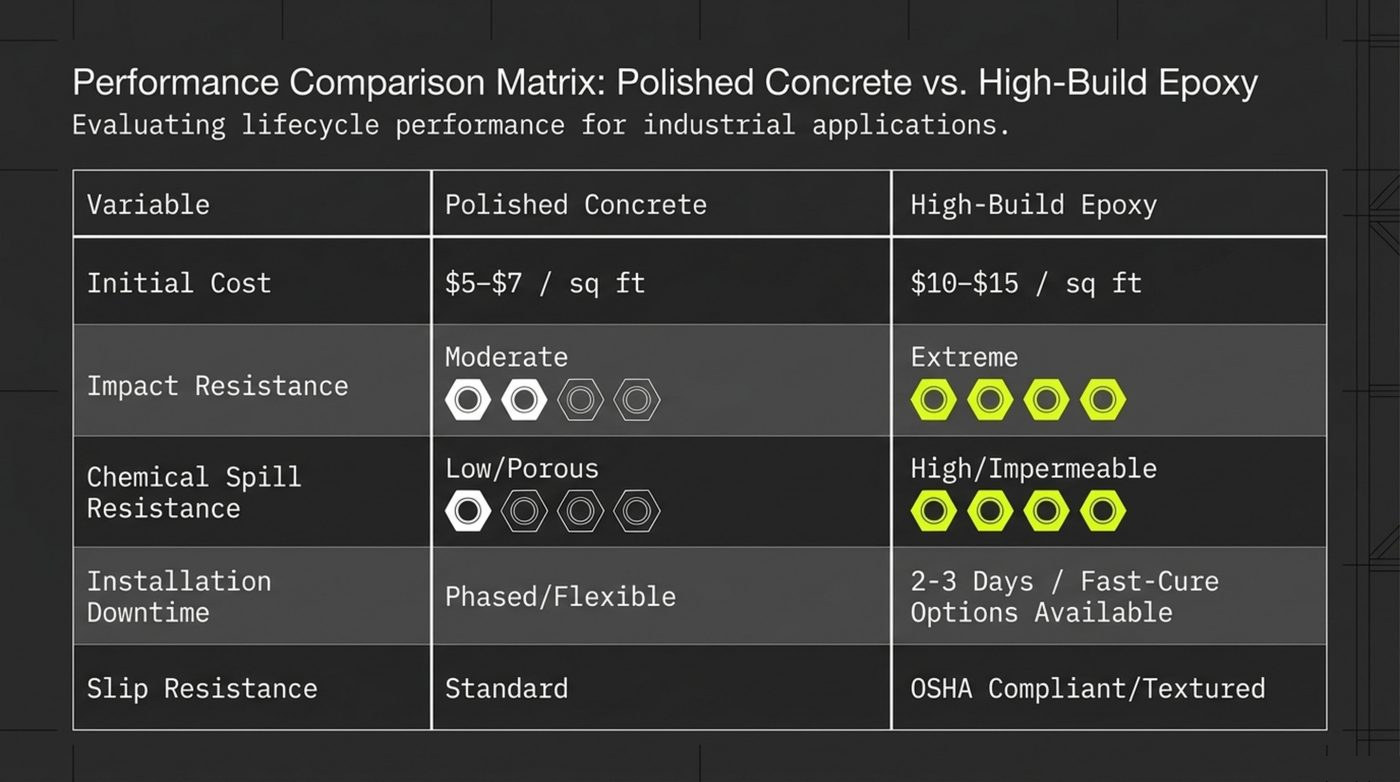
Five variables separate the two systems on a specification sheet, and they should be read together rather than as individual trade-offs.
| Variable | Polished concrete | High-build epoxy |
|---|---|---|
| Initial cost | $5-$7 / sq ft | $10-$15 / sq ft |
| Impact resistance | Moderate | Extreme |
| Chemical spill resistance | Low / porous | High / impermeable |
| Installation downtime | 2-3 days / fast-cure | Phased / flexible options available |
| Slip resistance | Standard | OSHA compliant / textured |
The cost difference is roughly double, and the return for that difference is concentrated in three rows: impact, chemical resistance and slip resistance. Where those three exposures are absent — clean, dry, automated storage — the extra spend on epoxy buys capability the operation will never use. Where they are present, a $5-$7/sq ft slab will fail in exactly the conditions that justify the higher system.
Downtime is the row that surprises facility managers. Polished concrete typically runs 2-3 days on a fast-cure schedule, while epoxy installations can be phased with flexible options available, which means a large facility in Holland can be worked in sections and kept partly operational instead of shutting a whole building for one continuous pour.
The chemical hazard spectrum: three exposure zones
Epoxy resistance is not a yes-or-no property. The profiles group common industrial exposures into three zones, and any facility that stores chemicals should map its inventory against them before specification.
| Zone | Exposure rule | Chemicals |
|---|---|---|
| Zone 1 | Long-term exposure: safe | Motor oil, ammonium hydroxide (20-38%), gasoline, sodium chloride, brine, brake fluid |
| Zone 2 | 72-hour exposure: clean quickly | Acetone (10%) |
| Zone 3 | Not resistant: avoid | Methylene chloride, sulfuric acid (50%), glacial acetic acid, aniline |
Zone 1 is where a well-specified floor is genuinely indifferent — motor oil, gasoline, sodium chloride and brine can sit without a deadline. Zone 2 requires discipline: an acetone spill must be cleaned within 72 hours. Zone 3 is a containment problem rather than a flooring problem, because methylene chloride, sulfuric acid at 50%, glacial acetic acid and aniline will attack the film itself. No coating choice removes the need for secondary containment around those four.
Heat, moisture and outgassing: why installations fail
The failure path is short and mostly determined before any resin is opened. Inadequate surface prep using grinding only, combined with high ground moisture reading as raised relative humidity, plus a rigid, slow-curing standard epoxy that traps outgassing — then extreme heat arrives. The result is vapour pressure bubbling and delamination, and it shows up as blisters that appear to come from nowhere weeks after a floor looked perfect.
The success path substitutes every link in that chain. Concrete cured for 28 days, moisture mitigation addressed, mechanical shot blasting to a CSP 3-4 profile, and a fast-cure polyaspartic or cyclo-aliphatic topcoat technology. The outcome is a flexible, secure bond that withstands temperature swings instead of fighting them.
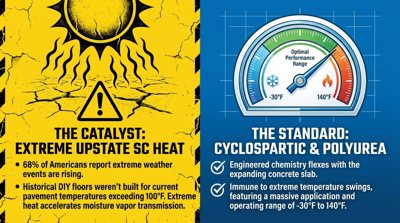
The variable that has changed is heat. Summer conditions in West Michigan now push slab surfaces into territory where rigid, slow-curing films lose the argument, and the MDOT brine and road salt that sit on loading aprons from November through April only widen the gap, which is why fast-cure topcoat systems have moved from an option to the default on industrial work.
Safety markings as permanent workflow boundaries
The other thing a coating can do that bare slab cannot is carry the facility's traffic logic in the floor itself. Permanent markings allow loading dock, hazard zone, pedestrian safe path, forklift thoroughfares and inventory staging areas to be defined in the coating rather than in tape.
Three properties make those markings worth specifying. They eliminate temporary floor tape and its replacement cycle. They resist heavy forklift tire scrubbing, which is what strips tape in the first weeks. And they carry permanent anti-slip aggregate integration, so a pedestrian safe path is textured where it matters instead of relying on a painted line to signal a boundary that a wet floor does not respect.
Decision guide: which system fits your facility
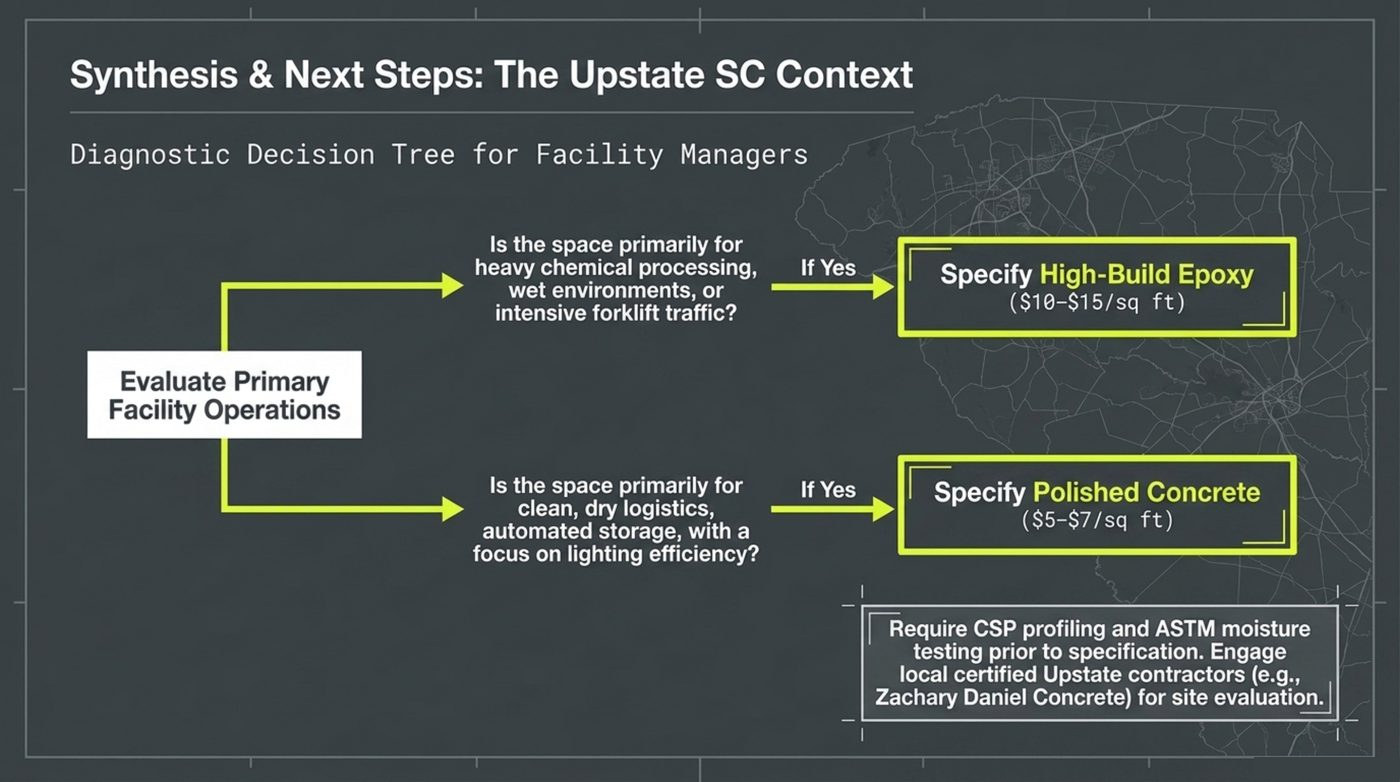
The selection resolves almost entirely to one question about operations, and the diagnostic decision tree handles it in two branches.
| If the space is primarily for | Specify | Budget line |
|---|---|---|
| Heavy chemical processing, wet environments or intensive forklift traffic | High-build epoxy | $10-$15 / sq ft |
| Clean, dry logistics, automated storage, with a focus on lighting efficiency | Polished concrete | $5-$7 / sq ft |
One requirement applies to both branches: CSP profiling and ASTM moisture testing are required prior to specification. Skip the moisture test and the system choice becomes irrelevant, because vapour pressure will find the weakest layer regardless of whether that layer is a densified slab or an epoxy film. Engage a local contractor for a site evaluation before committing to either number, and hold the testing results as part of the project record.
Frequently asked questions about industrial flooring systems
Why does high-build epoxy cost more than polished concrete?
Because it is a built system rather than a densified surface. A high-build epoxy installation adds an epoxy primer, a clear base coat with silica sand, a second sanded coat and a pigmented chemical and UV resistant topcoat to reach 20-35 mils. That build is what carries the $10-$15 per sq ft range against $5-$7 per sq ft for polished concrete.
Which system resists chemical spills better?
High-build epoxy, rated high and impermeable against low and porous for polished concrete. However, even epoxy has limits: methylene chloride, sulfuric acid at 50%, glacial acetic acid and aniline fall outside its resistance profile, while acetone at 10% must be cleaned within 72 hours.
What prep and moisture testing is required before either system?
Both require mechanical shot blasting to a CSP 3-4 profile plus ASTM moisture testing. For epoxy the substrate must also be 2500 psi and cured for 28 days. Skipping the moisture test is the most common cause of vapour pressure bubbling and delamination.
If you are specifying a floor for a facility in Wyoming, Holland, Kentwood or Grand Rapids, call Grand Rapids Epoxy Floors at (616) 616-7460 and we will help you work through the operating question first. For the residential version of the same comparison, see commercial epoxy flooring or the full set of comparison guides.