Installer safety and handling on a resinous flooring job
The curing agent in most resinous flooring systems is the part of the job that decides how a crew dresses. A cycloaliphatic amine curing agent carries a documented hazard profile, and the protocol that goes with it — eye protection, glove selection, body coverage, ventilation — is not paperwork. It is the difference between a two-day install in Grand Rapids and an emergency room visit.
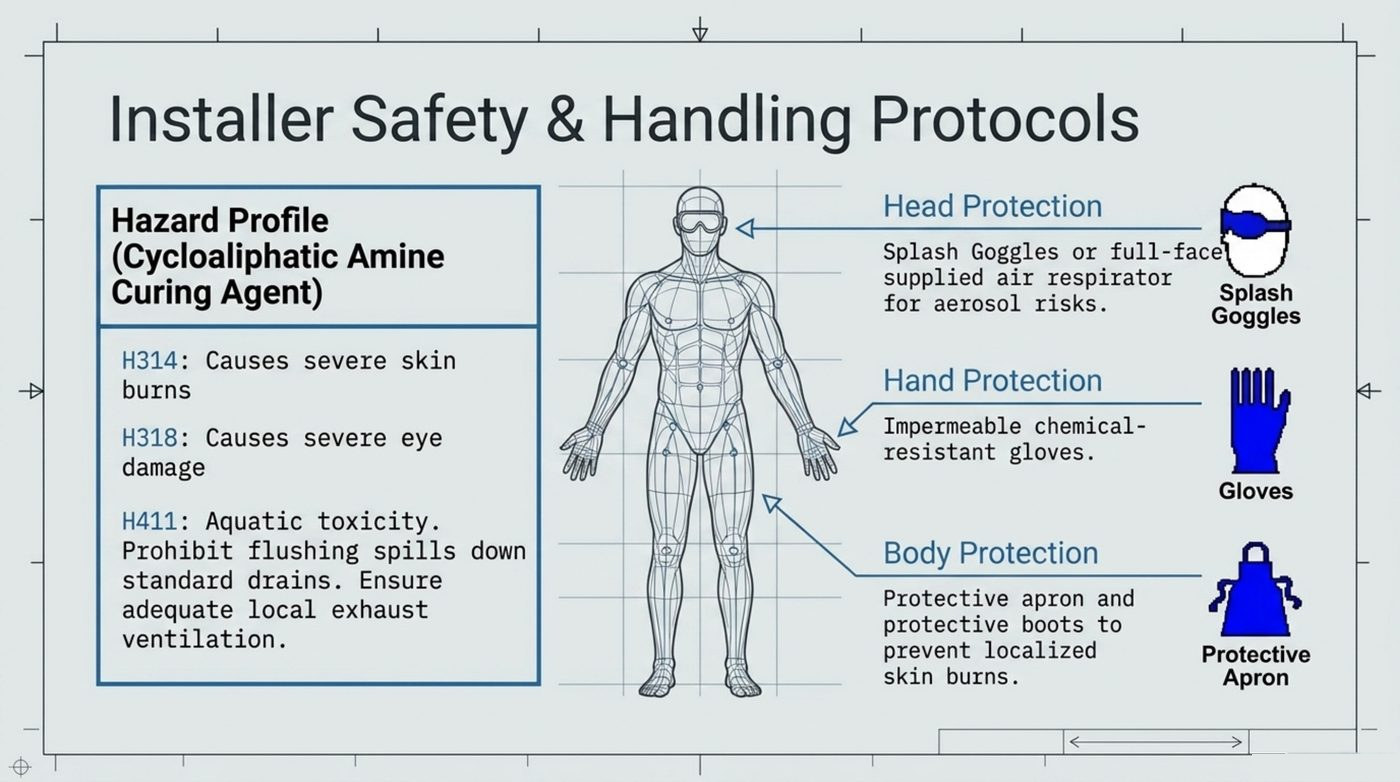
The hazard profile lists three codes. H314 causes severe skin burns. H318 causes severe eye damage. H411 notes aquatic toxicity. Those three lines explain almost every rule that follows: protect the eyes at the highest level, keep the material off skin with genuinely impermeable materials, and never let a rinse bucket go down a standard drain.
The short version
- The hazard profile of the cycloaliphatic amine curing agent lists three codes: H314 for severe skin burns, H318 for severe eye damage, and H411 for aquatic toxicity.
- Because of H318, the baseline eye protection is splash goggles rather than safety glasses, escalating to a full-face supplied air respirator wherever the work produces an aerosol.
- The glove requirement is impermeable rather than merely chemical-resistant, with nitrile exam gloves specifically ruled out and replacement expected before saturation.
- Body protection means a chemical-resistant apron and boots, since sleeves, cuffs, ankles, and laces are where incidental contact concentrates while a crew works pitched forward.
- The H411 aquatic toxicity rating drives the rule that rinse water and residue must never be flushed down standard drains, with absorbent material staged at the mixing station.
- Homeowners can check four visible signals: goggles on everyone near an open container, gloves replaced mid-job, apron and boots worn rather than shelved, and absorbent material staged at the mixing point.
Homeowners in Kentwood or Grandville rarely handle these products, but they do evaluate quotes. Knowing which protections a crew brings is one of the few objective quality signals available before a single drum is opened.
The hazard profile and what it demands
Every control on a resinous flooring job traces back to the hazard codes on the technical data sheet. Reading them together shows where the risk concentrates: eyes and skin take the direct damage, and the drains carry the environmental consequence.
| Hazard code | Meaning | Control |
|---|---|---|
| H314 | Causes severe skin burns | Impermeable chemical-resistant gloves, protective apron and boots |
| H318 | Causes severe eye damage | Splash goggles, upgraded to full-face supplied air for aerosol risks |
| H411 | Aquatic toxicity | Prohibit flushing spills down standard drains |
| Aerosol and vapour | Airborne exposure during mixing and spray | Adequate local exhaust ventilation at the work zone |
Eye protection: goggles first, supplied air when it aerosols
The baseline is splash goggles. A cycloaliphatic amine curing agent is rated H318 for severe eye damage, which rules out safety glasses, sunglasses and "I'll keep my head back" as strategies. Where the work generates an aerosol, the requirement escalates to a full-face supplied air respirator, because goggles stop droplets and not a cloud.
On a garage floor this matters most during mixing and during any sprayed application. Rolled systems in a East Grand Rapids garage with an open door release far less airborne material than a spray rig, which is exactly why the protection level should be matched to the application method rather than to the product name on the pail.
Hand protection: impermeable, not merely chemical-resistant
Gloves are the control for H314 severe skin burns, and the operative word in the spec is impermeable. Nitrile exam gloves are not the answer. The requirement is a chemical-resistant glove that resists permeation for the duration of the task, changed out before it becomes saturated rather than after.
Two small habits make the difference. Inspect the gloves before mixing, and remove and replace them the moment the material starts to reach the cuff. A curing agent that is rated for severe burns does not announce its failure mode — it works quietly through a swatch of fabric.
Body protection: apron and boots over comfort clothing
Body protection means a protective apron and protective boots, specified to prevent localised skin burns rather than to keep clothing clean. Sleeves, cuffs, ankles and laces are where incidental contact concentrates, because those are the points that pass closest to the floor while a crew works pitched forward with a roller.
Boots also settle the question of where a worker stands. A crew handling a strong-base curing agent should not be working in the material it is spreading, and the boot requirement forces a clean path in and out of the work zone on every trip to the mixing station.
Spill containment and ventilation on site
The H411 aquatic toxicity rating drives the spill rule: prohibit flushing spills down standard drains. That means absorbent material on hand before work starts, a containment boundary around the mixing station, and a plan for the rinse water, because rinsing a roller into a garage floor drain in Walker or Holland sends the residue into the storm path.
Ventilation is the other half. Adequate local exhaust ventilation keeps airborne concentration down at the work zone, which matters most in attached garages where the space sits under a bedroom rather than in a detached shed. Opening the overhead door is a starting point, not a ventilation plan — and in January that door stays shut against lake-effect snow, so mechanical exhaust has to carry the load — the airflow has to reach the mixing table and the low areas where vapour collects, and it has to keep running through the stages where the floor is still curing.
What a homeowner should look for before work starts
Four things are visible at a glance. Goggles on every person near an open container. Chemical-resistant gloves being replaced mid-job rather than worn to the edge of failure. A protective apron and boots on the crew, not on a shelf. And absorbent material staged at the mixing point alongside a ventilation plan for the room.
Ask what curing agent chemistry is in the system, and ask how the crew handles rinse water. A team that answers with hazard codes rather than reassurances is a team that has read its own data sheets. For the materials side of the same decision, the basement epoxy page and the project checklist cover what should be on site before coating begins.
Frequently asked questions about installer safety on resinous floors
What do hazard codes H314, H318 and H411 mean?
H314 means the material causes severe skin burns. H318 means it causes severe eye damage. H411 flags aquatic toxicity. Together they set the minimum protocol: impermeable gloves, splash goggles or a full-face supplied air respirator for aerosol risks, and no drain disposal.
Why are splash goggles required instead of safety glasses?
Because of H318, severe eye damage. Safety glasses protect against impact, not against liquid reaching the eye from a splash or a spray. Where the application produces an aerosol, the requirement escalates further to a full-face supplied air respirator.
Can leftover rinse water be poured down the garage drain?
No. The H411 aquatic toxicity rating means spills must never be flushed down standard drains. Contain rinse water and residue alongside the rest of the waste stream and keep absorbent material at the mixing station from the start of the job.
Safety questions are welcome before you book anything. Call Grand Rapids Epoxy Floors at (616) 616-7460 to talk through handling and ventilation for your Grand Rapids, Wyoming or Rockford space, or start with the commercial epoxy service page if the site is a working facility.