Why millimetres of thickness decide how long a floor lasts
Two garage floors in Grand Rapids can look identical on the day they are finished and behave completely differently three winters later. The variable is thickness. A retail box kit builds a film measured in single-digit mils. A professional multi-layer system builds one measured in the tens of mils, and that physical gap is what decides how much abuse the floor can absorb before it shows.
Thickness is measured in mils of dry film, the depth left behind after the coating has cured. Multiply that by layer count and you get the total protective barrier over the slab. It is the least visible number in any quote and the one that most reliably predicts lifespan in Kentwood, Walker, Wyoming, Grandville, East Grand Rapids, Rockford, and Holland.
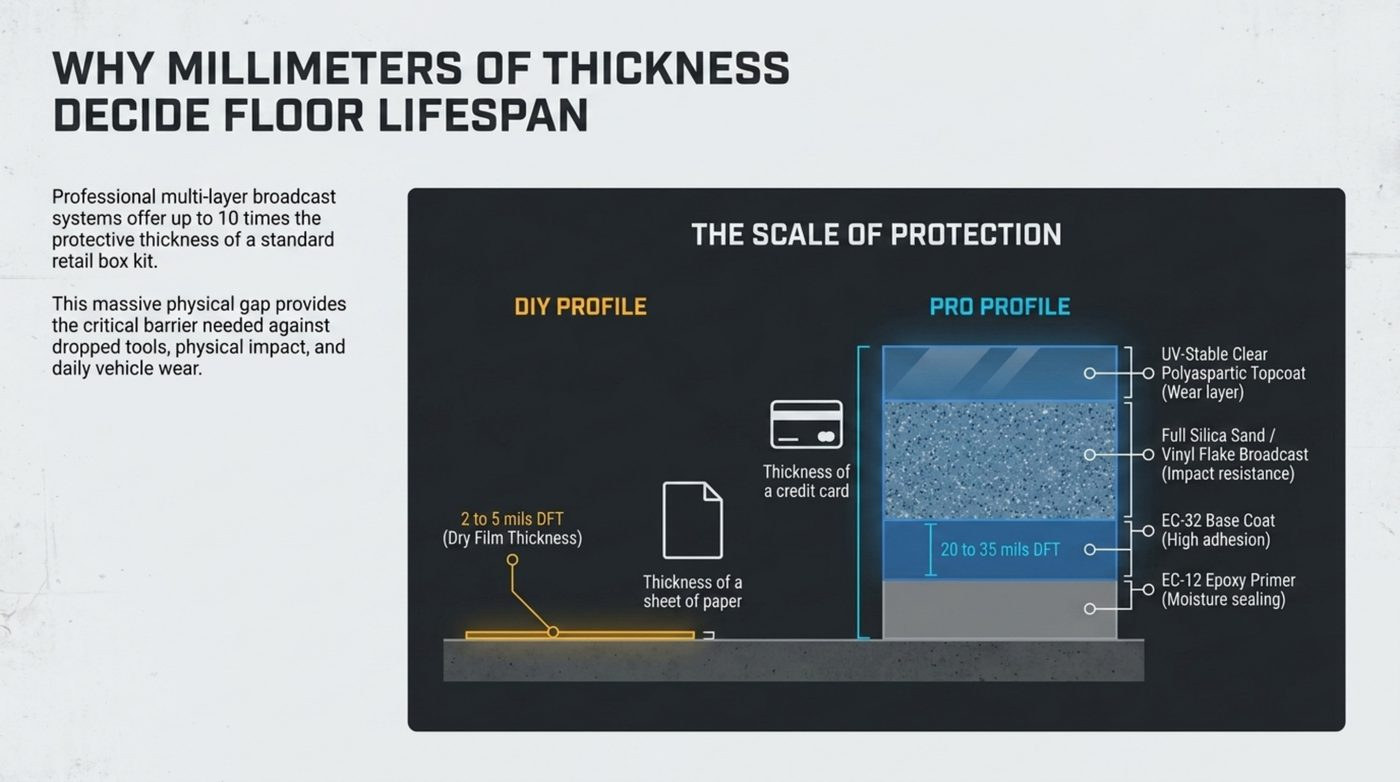
Here is what the two profiles actually look like in cross-section, and why professional multi-layer broadcast systems offer up to 10 times the protective thickness of a standard retail box kit.
Reading a floor in dry film thickness
A DIY profile lands between 2 and 5 mils of dry film thickness. That is roughly the thickness of a sheet of paper. It is enough to change the colour of the concrete and give a temporary sheen, but it is not enough material to spread an impact or hold a broadcast aggregate.
A professional profile lands between 20 and 35 mils of dry film thickness, closer to the thickness of a credit card. That is a film you can feel the depth of, and it is built in sequence rather than in one pour.
Ten times the thickness does not mean ten times the price. It means ten times the material over the same slab, which is why the protective barrier behaves differently for the entire life of the floor.
What each layer is doing
A professional build starts with an epoxy primer that seals moisture in the slab and gives the system its first continuous bond. Above that sits a base coat formulated for high adhesion, the layer that carries the mechanical and chemical grip of the whole assembly.
On top of the base coat comes a full broadcast of silica sand or vinyl flake. This is the impact resistance layer, and it is the step no retail kit replicates. The aggregate is broadcast to refusal, which means the surface is saturated until it cannot accept more, then the excess is scraped back.
Last is a UV-stable clear polyaspartic topcoat. That is the wear layer, the surface the tires, the jack stands, and the snow shovels actually touch.
| Profile | Dry film thickness | Physical comparison | Built-in protection |
|---|---|---|---|
| DIY box kit | 2 to 5 mils DFT | Thickness of a sheet of paper | Single thin film, no broadcast layer |
| Professional system | 20 to 35 mils DFT | Thickness of a credit card | Primer, base coat, aggregate broadcast, wear topcoat |
Impact resistance is a function of mass
A dropped tool concentrates a large force into a small area. A 2 to 5 mil film has almost no material to distribute that force, so the energy reaches the concrete and chips the coating around the point of contact.
A 20 to 35 mil film, reinforced with a broadcast aggregate, absorbs and spreads the same force across a wider footprint. The damage, if any, is a scuff in a renewable wear layer rather than a crater in the slab.
This is the gap the phrase "up to 10 times the protective thickness" is describing. It is not marketing language, it is the arithmetic of a multi-layer build against a one-coat kit.
The barrier against daily vehicle wear
A car parked in the same spot for years transfers grit, salt, and heat into the surface under each tire. Over a five-month salt season, that repeated loading abrades the top of the floor rather than the whole depth of it.
With a wear layer and a broadcast layer beneath it, that abrasion is gradual and structural. With a thin film, the same wear goes straight through to the bond line and the failure starts there.
UV stability and the colour of the floor
A UV-stable clear topcoat is what keeps a floor from ambering in a garage with windows or an open door facing the sun all afternoon. Thin films without that layer discolour first, and the discolouration is permanent.
In Grand Rapids and Holland, where new garages are often wide and bright, that topcoat is the difference between a floor that still matches its original flake colour in year eight and one that has gone yellow while the walls did not.
Frequently asked questions about coating thickness
What is dry film thickness in floor coatings?
It is the depth of the cured coating left on the slab, measured in mils. A DIY box kit finishes at 2 to 5 mils DFT, while a professional multi-layer system finishes at 20 to 35 mils DFT.
Does a thicker floor cost proportionally more?
No. The professional profile uses up to 10 times the material of a retail kit, but not 10 times the labour or overhead, which is why per-square-foot pricing stays in a workable range.
Can a thin floor be built up later?
Not by adding coats on top of a failed film. Thickness has to be built from a prepared slab, which is one reason a floor that has started to peel is ground back and rebuilt rather than topped up.
If you want to know what thickness your garage actually needs, the tools hub has calculators for square footage and material volume, and our flake and chip systems page shows how a broadcast layer looks once it is installed. Call Grand Rapids Epoxy Floors at (616) 616-7460 and we will help you compare local providers.