The prep battle: acid etch vs a CSP 3-4 mechanical profile
Every failed garage floor in West Michigan has a story, and almost none of those stories start with the coating. They start with the surface underneath it. If the concrete was never prepared properly, the best coating on the market is simply a very expensive sheet of material sitting on top of a dirty slab. Most homeowners who read this are comparing concrete coating installers options around Grand Rapids, MI, so what follows sticks to the details that change in practice.
There are two ways to prepare concrete before a coating: a chemical scratch and a mechanical pore. One of them is a bottle of acid and a hose. The other is diamond grinding and shot blasting that opens the concrete so the coating becomes part of the floor.
The short version
- An acid etch eats into the top layer of cement paste and leaves the slab feeling rougher, but it does not remove sealers, old paint or deep motor oil contamination.
- Diamond grinding and shot blasting cut through those layers to reach an ICRI Concrete Surface Profile of CSP 3-4, which opens the pores so the coating locks in mechanically and chemically.
- The equipment is a walk-behind shot blaster in the 1,250 class for the bulk of the surface, a planetary grinder for edges and corners, and a HEPA extractor for the dust.
- CSP 3-4 is a coarse, uniformly open profile and the window where a 20-35 mil system bonds deeply without telegraphing texture through the finished topcoat.
- A coating that peels in sheets shows a preparation failure rather than a product failure, because on a properly profiled slab the concrete breaks before the chemical bond fails.
The difference between them shows up in numbers you can specify, and it shows up in every hot-tire blister and lifted edge you see on a Grand Rapids driveway a few years later.
The chemical scratch: what an acid etch really does
An acid etch is sold as surface preparation because it is cheap, fast, and requires nothing more than a bucket, a brush, and a garden hose. It works by eating into the top layer of cement paste, which leaves the slab feeling rougher than it was.
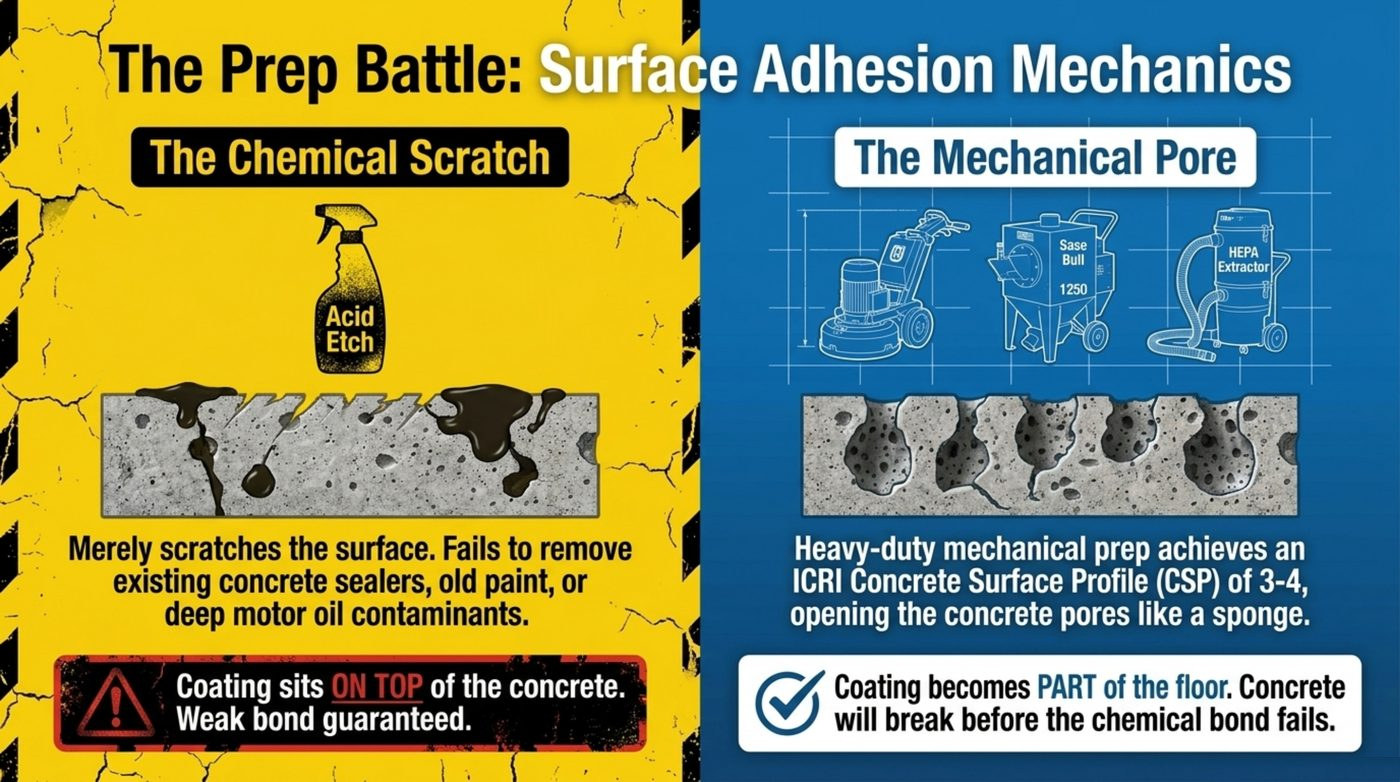
Rougher, however, is not the same as clean or profiled. An acid etch merely scratches the surface. It fails to remove existing concrete sealers, old paint, or deep motor oil contaminants, because those materials are not cement paste — they sit on top of it, and acid does not dissolve them away.
Whatever is left behind becomes the bond line. Sealers and oil act as a release layer between the concrete and the coating, and on that kind of surface the coating sits on top of the concrete rather than in it. The result is a weak bond, and a weak bond is not a risk you manage over time — it is a failure you have already purchased.
The mechanical pore: grinding and shot blasting
Heavy-duty mechanical preparation does a different job entirely. Diamond grinding and shot blasting cut through sealers, paint, and surface contamination, and they leave behind a deliberately textured profile that mechanical equipment produced.
That profile is what the industry measures. The work achieves an ICRI Concrete Surface Profile of CSP 3–4, which opens the concrete pores like a sponge. A coating applied to that surface flows into the pores and locks in place, so the bond is mechanical and chemical at the same time.
Once the pores are open, the relationship between coating and floor changes completely. The coating becomes part of the floor rather than a layer resting on it, and on a properly profiled slab the concrete will break before the chemical bond fails.
The equipment matters here, because a profile is not created by a roller. A walk-behind shot blaster in the 1,250 class handles the bulk of the surface, a planetary grinder works the edges and tight corners where the blaster cannot reach, and a HEPA extractor captures the dust the process generates. Skip the extractor and you have introduced a new contamination problem while solving the old one.
What CSP 3-4 means on a spec sheet
The Concrete Surface Profile scale is how the industry describes surface texture in a way that can be measured and repeated rather than argued about. A CSP 3–4 finish is a coarse, uniformly open profile — the range that manufacturers of full-thickness coating systems typically require for garage and commercial floors.
It is not a cosmetic setting. A profile that is too shallow gives the coating nothing to grip, and a profile that is too aggressive wastes material and can leave visible texture through the finished floor. CSP 3–4 is the window where a 20–35 mil system bonds deeply without telegraphing texture through the topcoat.
When a contractor quotes your floor, this is the number to ask for. If the answer is "we acid wash it", the profile is whatever the acid happened to leave — which is to say, none.
| Preparation factor | Acid etch (chemical scratch) | Mechanical profile (grinding and shot blasting) |
|---|---|---|
| Mechanism | Merely scratches the surface | Achieves an ICRI profile; opens the concrete pores like a sponge |
| Existing sealers and paint | Not removed | Removed by cutting the surface |
| Deep motor oil contamination | Not removed | Ground away with the contaminated layer |
| Specified surface profile | None stated | ICRI CSP 3–4 |
| Where the coating ends up | Sits on top of the concrete | Becomes part of the floor |
| Expected bond outcome | Weak bond guaranteed | Concrete will break before the chemical bond fails |
| Dust and debris control | Wet slurry | HEPA extractor |
Why the prep decision cannot be undone later
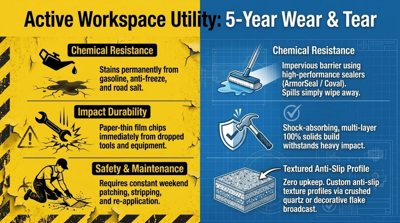
Everything that follows installation depends on this step. A coating bonded to a properly profiled slab handles five months of MDOT salt and brine, hot tires, and freeze-thaw cycling because the bond is stronger than the stresses acting on it. A coating bonded to an acid-etched slab handles none of those things, because the stresses only have to beat the release layer between the film and the concrete.
Repair work is where this becomes expensive. When a bond fails, the fix is not a patch over the top — the loose coating has to come off, and the slab has to be profiled properly before anything new goes down. The prep you skipped the first time is prep you pay for on the second attempt.
Homeowners in Kentwood and Walker often assume their floor failure was caused by the product. A coating that peels in sheets rather than wearing through is a preparation failure.
How to verify prep before the coating goes down
You do not need to watch the entire job, but you should confirm three things. First, that the agreed method is mechanical — diamond grinding and shot blasting — rather than an acid wash. Second, that the target is a stated ICRI Concrete Surface Profile of CSP 3–4. Third, that dust from grinding or blasting is being captured by a HEPA extractor rather than blown around the garage.
Visual confirmation is straightforward: after proper prep, the slab should be uniformly open and light in colour, with sealer and paint gone, oil staining removed, and no glossy patches remaining. The surface should look like a sponge that has been opened up, not like concrete that has been wiped with acid.
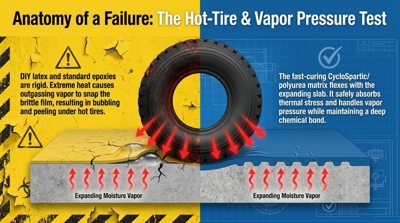
Ask about moisture testing as well, since a slab in a Grandville or Rockford garage can look dry while still feeding vapour upward under heat.
Frequently asked questions about concrete surface profile and prep
Is acid etching ever good enough for a garage floor?
Not for a full-thickness system on a West Michigan slab. An acid etch merely scratches the surface and leaves existing sealers, old paint, and deep motor oil contaminants in place, which guarantees a weak bond. Mechanical preparation to CSP 3–4 is the specification that gives the coating something to hold.
What is CSP 3-4 and why does it matter?
It is an ICRI Concrete Surface Profile rating describing a coarse, uniformly open texture. CSP 3–4 gives a 20–35 mil coating enough pore structure to lock into, while staying inside the range that avoids telegraphing texture through the finished floor.
Can I tell from the finished floor whether prep was done properly?
Look at how it fails, if it fails. A floor bonded to a profiled slab will damage the concrete before the bond releases. A floor that peels away in sheets shows the coating was sitting on top of the concrete rather than part of it.
If your current floor lifts at the edges or peels in sheets, the prep was the problem — and it is fixable. Call (616) 616-7460 for a free assessment in Grand Rapids, Kentwood, Walker, Wyoming, Grandville, East Grand Rapids, Rockford, and Holland, work through our prep and installation checklist, or compare system options on the comparison hub before you re-coat.