The prep work determines the lifetime
Ask an installer in West Michigan what actually kills epoxy floors and the answer will not be the resin. It will be the preparation. Without heavy mechanical abrasion to achieve a concrete surface profile of 3 to 4, the substrate stays too smooth, and the best chemical coating in the world will fail on a slab that was never given anything to grip.
Concrete surface profile, or CSP, is the roughness standard that describes how aggressively the surface has been opened. It is a small number with an enormous effect: a CSP of 3 to 4 creates a deep texture for mechanical lock, while a CSP of 1 does not. Every promise made by a coating assumes that number has already been met.
This is the step homeowners in Grand Rapids, Kentwood, Walker, Wyoming, Grandville, East Grand Rapids, Rockford, and Holland most often underestimate, because preparation produces no visible progress. A floor being ground looks worse than a floor being painted, right up to the moment it is finished.
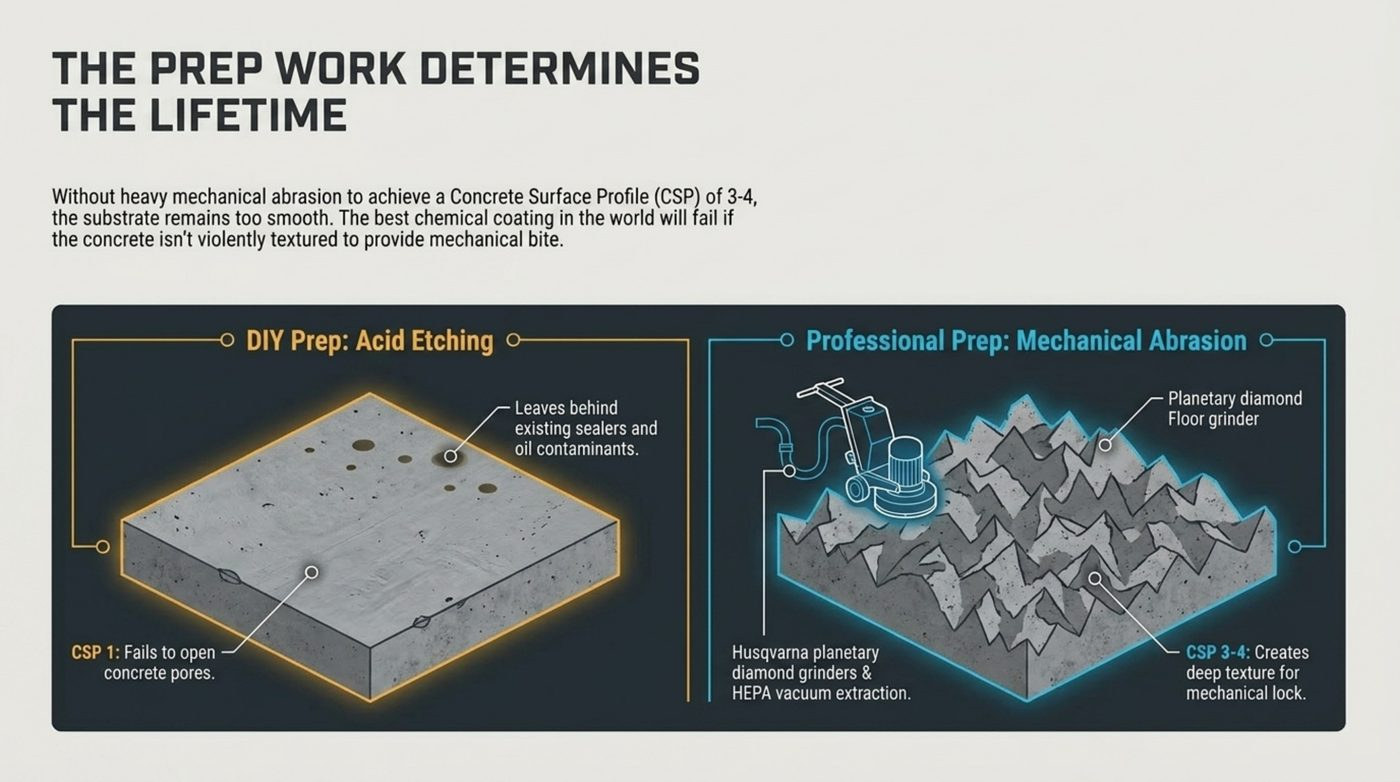
CSP 3 to 4 versus CSP 1
CSP 3 to 4 means the concrete has been cut back to a visibly rough, open texture, similar to medium-grit sandpaper on a slab scale. That profile is what a high-build resin needs in order to cross-link into the pores rather than rest on top of them.
CSP 1 is a much lighter profile, closer to the surface of a new, troweled slab. It fails to open concrete pores in any meaningful way. A coating applied over that surface has surface grip and nothing more, which is the same failure mode as a retail kit.
The number is not a preference. It is the physical requirement the coating manufacturer builds the product around, and it is the reason preparation can take longer than the coating itself.
DIY preparation: acid etching and what it leaves behind
The retail answer to preparation is acid etching. You pour, scrub, rinse, and let the slab dry. For a floor that only needs to look good for a season, it can be enough.
What acid etching does not do is open the pore structure mechanically, and it does not remove what is already on the concrete. It leaves behind existing sealers and oil contaminants, which are precisely the layers a new coating cannot bond through. Etching a sealed slab mostly just cleans the sealer.
The result is a floor that meets roughly a CSP 1, which is why DIY installs fail at the bond line before they fail at the surface.
Professional preparation: mechanical abrasion
A professional crew uses planetary diamond floor grinders to cut the surface back to a true CSP 3 to 4. The machine moves in overlapping passes with controlled depth, so the profile is consistent across the whole slab rather than deep in one corner and shallow in another.
Grinding is paired with HEPA vacuum extraction, which captures the fine silica dust at the head as it is produced. That matters in an occupied home in Wyoming or East Grand Rapids, where the garage shares a wall with living space and dust control is not optional.
The same pass also removes old sealers, oil contamination, and failed coatings, so the new system starts on bare, profiled concrete instead of someone else's leftover chemistry.
| Prep stage | DIY acid etching | Professional mechanical abrasion |
|---|---|---|
| Method | Acid etch, scrub, rinse | Planetary diamond floor grinding |
| Profile achieved | CSP 1, fails to open concrete pores | CSP 3 to 4, deep texture for mechanical lock |
| Sealers and oil | Leaves behind existing sealers and oil contaminants | Ground away to bare, open concrete |
| Dust control | Hand rinse, no extraction | HEPA vacuum extraction at the grinder head |
Why a smooth slab rejects the best coating
A coating is only as good as the surface it is applied to. Put the most chemically advanced resin available onto a slab that has never been profiled and it will still delaminate, because delamination is a preparation failure, not a product failure.
This is the single most common reason a floor that looked flawless in spring is lifting by the following spring, after one West Michigan freeze-thaw season. The chemistry did its job. The slab was never given the texture that job required.
What a proper prep sequence includes
- Grinding the full slab to CSP 3 to 4, including under the parked car footprint where oil has soaked in
- Opening cracks and control joints so they can be filled with a rigid epoxy rather than hidden under the film
- Vacuuming the surface twice, once after grinding and once immediately before the primer goes down
- Checking the slab for moisture so the primer can do its sealing job before any coating is applied
Frequently asked questions about floor preparation
What is a concrete surface profile of 3 to 4?
It is a medium-rough texture, opened mechanically with diamond grinding. CSP 3 to 4 gives a coating a deep mechanical lock, while a CSP 1 surface is too smooth for a coating to hold.
Is acid etching enough before applying epoxy?
No. Acid etching typically achieves only a CSP 1 and leaves existing sealers and oil contaminants in place, so the coating bonds to the surface rather than to the concrete.
Why does the grinding step take so long?
Because it has to be consistent across the entire slab. Overlapping passes, edge work, crack opening, and HEPA extraction all happen before a single litre of resin is mixed.
If you want to know what to expect on install day, our epoxy flooring checklist lists the preparation steps a provider should be able to describe, and the comparison guides show how systems differ once the prep is done. Call Grand Rapids Epoxy Floors at (616) 616-7460 to be matched with local providers in Grand Rapids and across West Michigan.