2-5 mils vs 20-35 mils: the material gap that decides floor lifespan
Two garage floors in the same Grand Rapids neighbourhood can be coated on the same weekend and look identical on Sunday night. Within two years one of them is mopped and the other is patched, and the difference is written on the spec sheet as two small numbers: dry film thickness.
Dry film thickness, usually shortened to DFT, is what is actually left on the slab after the coating cures. It is the number that decides whether a floor shrugs off a dropped wrench, a hot tire, and five months of MDOT road salt and brine — or whether it dries to a film so thin that it behaves like a coat of paint.
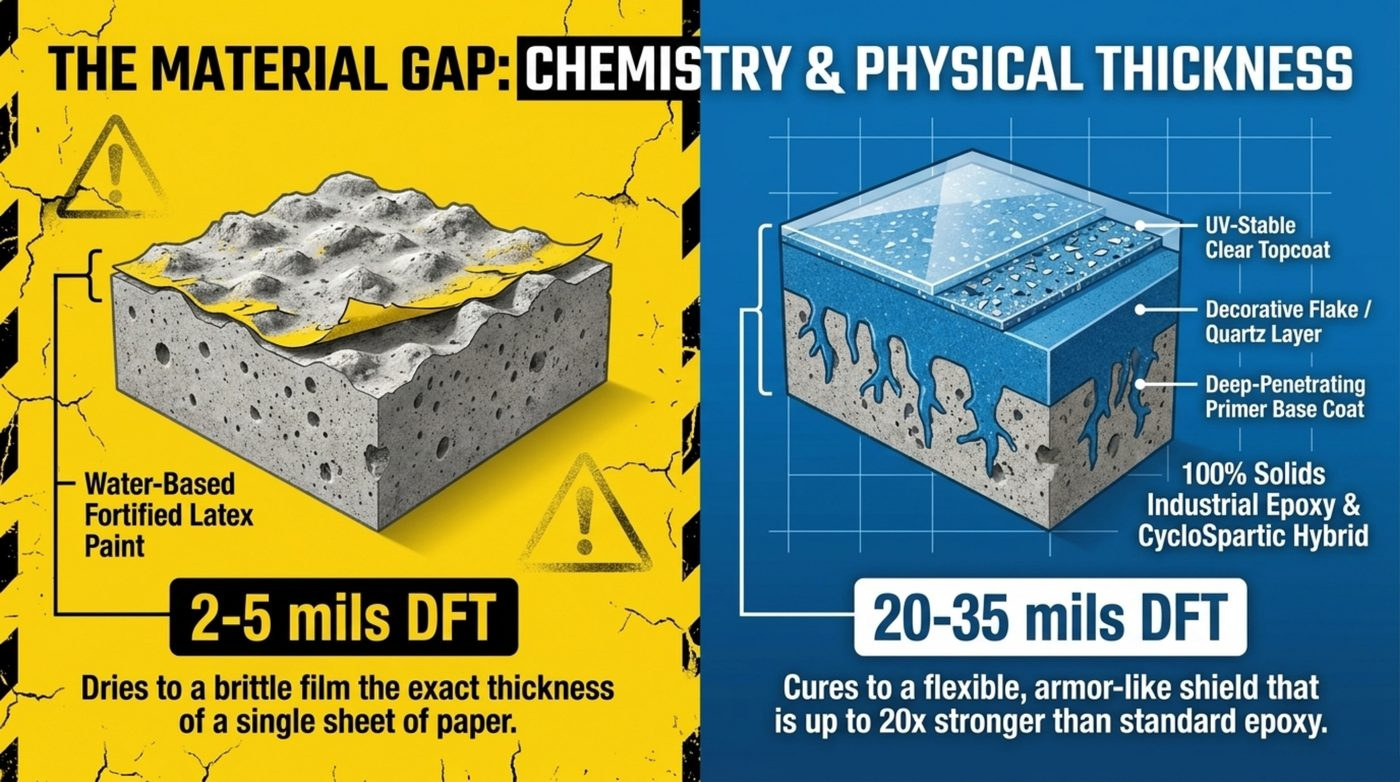
The gap in the market is wide. Water-based and fortified latex paints finish at 2–5 mils DFT, while a 100% solids hybrid system builds to 20–35 mils DFT. Everything else in this article explains the consequences of that gap.
What a mil actually measures
A mil is one thousandth of an inch, and it is measured on the dry film, not on the wet coating going into the bucket. That distinction matters because different chemistries lose different amounts of volume as they cure. A water-based product loses most of its volume to evaporation; a 100% solids product keeps essentially all of it.
So the same wet film thickness can leave two very different floors behind. That is why a quote written in gallons per square foot, or in number of coats, tells you very little. The specification that matters is the dry film thickness of the finished system, stated in mils.
A 2–5 mil film is not a figure of speech. It is the exact thickness of a single sheet of paper sitting on top of concrete. At that gauge there is no material left to sacrifice before the concrete is exposed to another West Michigan salt season.
The build-up: why a real system has three layers
A full-thickness system is not one thick pour. It is a stack. A deep-penetrating primer base coat goes on first, keys into the concrete, and gives the next layer something to hold. A decorative flake or quartz layer goes over that, adding both colour and physical abrasion resistance. A UV-stable clear topcoat finishes the build and protects the layers below from sunlight.
Each layer contributes part of the 20–35 mil total, and each one has a job. The primer manages adhesion. The flake layer manages wear. The clear topcoat manages UV exposure, which is what keeps a garage floor from turning amber in a sunny Grandville driveway. Remove any layer and the system loses that function entirely.
A DIY kit typically skips the stack. One application of pigmented product, spread as far as the bucket allows, leaves the paper-thin film that the whole failure pattern starts with.
Why 20x stronger is a thickness and chemistry statement
A 100% solids hybrid finishing at 20–35 mils cures into a flexible, armour-like shield that is up to 20x stronger than standard epoxy. That multiple is not a claim about a single ingredient — it is the combined result of full film build and a cured film that can flex rather than snap.
A thin film fails differently at every point of impact. A dropped floor jack concentrates force into a few square mils, and because there is so little material under the load, the film chips immediately and exposes bare concrete. The same impact on a 20–35 mil build is spread through a shock-absorbing multi-layer structure that was designed to take it.
The maintenance consequence follows directly. Paper-thin film means constant weekend patching, stripping, and re-application. Full-thickness build means simple mopping, because the floor has nothing to shed and nowhere to leak.
The chemistry side of the same decision
Thickness alone is not the answer, because a rigid coating at 20–35 mils is still rigid. The chemistry is what lets thickness do its job. A flexible hybrid matrix moves with the slab through West Michigan's winter lows, its summer heat, and the five months of salt and brine in between, while a rigid latex or standard epoxy film of the same gauge would still crack when the concrete beneath it moves.
That is the real meaning of the material gap. Thin and brittle is the worst combination, because the film has neither the body to resist impact nor the flexibility to survive movement. Thick and flexible is the combination that holds both properties at once, which is why the two numbers — 20–35 mils, 100% solids — belong in the same sentence and on the same quote.
| Specification | Water-based and fortified latex paint | 100% solids hybrid system |
|---|---|---|
| Dry film thickness (DFT) | 2–5 mils | 20–35 mils |
| Cured film character | Dries to a brittle film, the exact thickness of a single sheet of paper | Cures to a flexible, armour-like shield |
| Relative strength | Baseline | Up to 20x stronger than standard epoxy |
| Solids content | Water-based | 100% solids |
| System build-up | One thin pigmented film | Deep-penetrating primer base coat, decorative flake or quartz layer, UV-stable clear topcoat |
| Impact from dropped tools | Chips immediately | Shock-absorbing multi-layer build withstands heavy impact |
How to verify thickness on your own job
Ask what dry film thickness the finished floor is specified to reach, and ask how many separate applications add up to it. A professional quote should be able to answer in mils without hesitation, because the number is what the material cost was calculated from.
Ask about the layers too. If the answer describes a single application of one product, you are buying a 2–5 mil result regardless of the brand on the bucket. If the answer describes a primer, a flake or quartz layer, and a UV-stable clear topcoat, the thickness has somewhere to come from.
And ask what the coating is expected to look like at five years, not at five days. Full build is the reason a floor in Wyoming or East Grand Rapids still looks like a floor after a decade of parking, salted tires, and dropped tools, rather than a patchwork of repairs.
Frequently asked questions about mils and coating chemistry
How thick is 20–35 mils in practical terms?
It is a film with body. Where a 2–5 mil coating matches the thickness of a single sheet of paper, a 20–35 mil build is a multi-layer shield with a primer base, a decorative flake or quartz layer, and a UV-stable clear topcoat on top.
Does a 100% solids coating really perform better than water-based?
It cures without losing its volume to evaporation, so the film that ends up on the slab is the film that was specified. Water-based and fortified latex products finish thin and brittle, at 2–5 mils DFT, which is why they chip and peel while a 20–35 mil hybrid holds.
Can I add more coats of a thin product to reach 20–35 mils?
Multiple coats of a film that dries brittle still dry brittle, and the time between coats adds days of downtime. The 20x strength figure comes from a full build in a flexible chemistry, not from repeating a thin film until the number looks right.
Before you sign anything, ask for the dry film thickness in writing and compare it with our DIY versus professional analysis. If you want to know what different thickness specifications cost on a West Michigan slab, call (616) 616-7460 for a free estimate in Grand Rapids, Kentwood, Walker, Wyoming, Grandville, East Grand Rapids, Rockford, and Holland, or start with the Grand Rapids cost breakdown.